Herbert Dash

Herbert Dash, my first cousin four times removed on my mother’s side, was descended from Sarah Gill and Charles Bester, his grandparents, and my 4th great grandparents. As illustrated below, he is one of three brothers who served during the war.  His brothers, as well as two of his first cousins, will be the subjects of future posts.

Dash

Abbreviated tree of Herbert Dash.

Charles Bester, son of John Bester and Mary Constable, was born in Little Eversden, Cambridgeshire, in 1833, and Sarah Gill, second daughter of John Gill and Elizabeth Munns (of whom you can read more here), was born in 1837 in Orwell, Cambridgeshire.  They had ten children, including Annie Bester, my 3rd Great Grandmother, and Elizabeth Bester, born in 1863, Herbert’s mother.

Elizabeth Bester was the 5th of the Bester children. By the age of 18, she was a servant in the home of the Roads family in Orwell, Cambridgeshire. In 1885, at the age of 22, she married 19-year old farm labourer Walter Dash, also of Cambridgeshire.  They had seven children between 1885 and 1895, Herbert being the second youngest, born in 1894.

In 1909, 15-year old Herbert joined the Royal Navy as Boy, 2nd Class, beginning his service at HMS Ganges. Between 1910 and 1914 he served aboard several ships including HMS Berwick in the West Indes, HMS Hampshire (the famous ship that sank after hitting a mine in 1916, killing most on board including Lord Kitchener), and HMS Zealandia.

When the war began in the summer of 1914, 20-year old Herbert was aboard HMS Black Prince, which was stationed in the Mediterranean. The first part of the war was spent patrolling for German merchant ships, and by December 1914, she was transferred to the Grand Fleet.  Eighteen months later, she was one of 250 ships that engaged in the deadly Battle of Jutland. The German High Seas Fleet had hoped to surprise the British Fleets, but codebreakers alerted the British to the approaching ships.  The clash began on the afternoon of May 31, 1916 off the coast of Denmark.  Black Prince, approaching the battle with the rest of the Grand Fleet from the north, was somehow separated from the rest of the fleet.  At the time, what happened to the ship was a mystery to the British forces, but German records have since revealed that she approached the German ships in the darkness, potentially thinking the outlines of the ships were British, just before midnight.    This mistake proved deadly.  Once spotted, Black Prince was fired on by six German battleships.

Devon Heritage (devonheritage.org) cites an eyewitness account of the aftermath from a crew member who had been on board HMS Spitfire:

“We were just recovering from our ramming match with the German cruiser, and most of the ship’s company were collected aft, when suddenly there was a cry from nearly a dozen people at once: “Look out!”

I looked up, and saw a few hundred yards away on our starboard quarter, what appeared to be a battle cruiser on fire, steering straight for our stern. To our intense relief, she missed our stern but just by a few feet; so close was she to us that we were actually under her guns, which were trained out on her starboard beam, She tore past us with a roar, rather like a motor roaring up a hill in low gear, and the very crackling and heat of the flames could be heard and felt. She was a mass of fire from fore-mast to main-mast, on deck and between decks. Flames were issuing out of her from every corner.

At first sight she appeared to be a battle cruiser, as her funnels were so far apart but afterwards it transpired that she was the unfortunate Black Prince with her two centre funnels gone. Soon afterwards, soon after  midnight, there came an explosion from the direction in which she had disappeared.”

All 857 officers and crew were lost.  Combined, the German and British forces lost 25 ships and over 8,500 men that day.

Herbert Dash, along with many others who lost their lives at the Battle of Jutland, is commemorated at the Portsmouth Naval Memorial.  I am honoured to post a memorial certificate to my cousin here.
 

Nellie Richmire and Edward Clinton Biccum

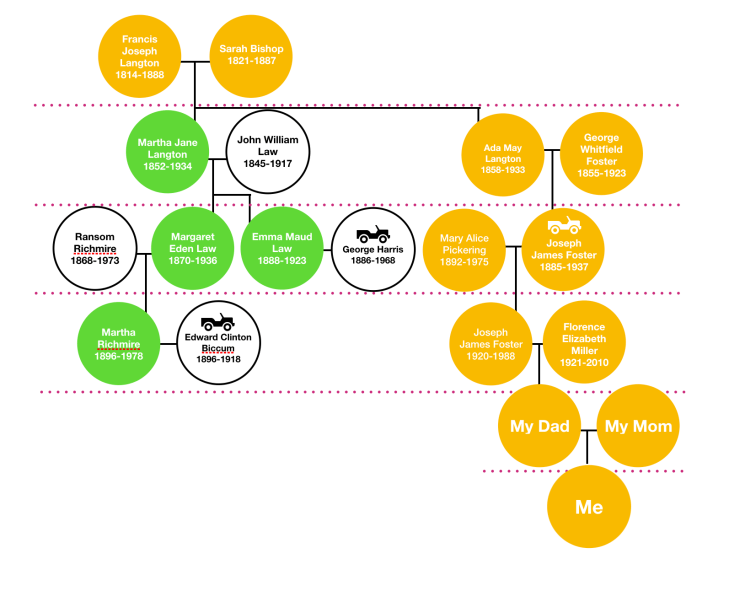
Martha “Nellie” Richmire was my 2nd cousin twice removed on my father’s side.  Like Emma Maud Law who I profiled in December, Nellie Richmire is also descended from Francis Joseph Langton and Sarah Bishop, my 3rd great grandparents, and Nellie’s great grandparents. As the abbreviated tree below demonstrates, Emma was in fact Nellie’s aunt.

Langton and Law abbreviated tree

Nellie’s mother, Margaret Eden Law, was the oldest child of Martha Jane Langton and John William Law. She was born in 1871, and married in 1889 to Ransom Richmire,  a teamster in Cardinal, Ontario, when her youngest sister, Emma, was only one year old.  Nellie was born in 1896 in Cardinal, where she lived with her family until marrying Edward Clinton Biccum in June of 1915.  She was 19, and Edward was 18.

Of course, when they married, the war had already been raging in Europe for 10 months, and Canada was immersed with it.  Local battalions were being created in counties across the country, and, starting in late 1915, the 156th battalion began recruiting in Grenville and Leeds counties.  Cardinal, where Edward was born, was in Grenville county, and on February 6, 1916, almost exactly 102 years ago, he travelled to the neighbouring town of Iroquois, Ontario to attest to the Canadian Expeditionary Force in the 156th.

Canadian_Expeditionary_Force,_156th_O.S._Battalion,_Barriefield,_July_7,_1916_(HS85-10-32558)

The 156th Battalion before sailing to Britain.  One of these men is Edward Clinton Biccum.

Cardinal is a beautifully situated village on the St. Lawrence River, directly across from New York State.  It is still a small community described as and “industrial” village, as has been its primary industry since the late 18th century.  Edward identified himself as a “labourer” on his attestation papers, and it is likely he worked in one of the mills.

On the day that he attested, his wife Nellie was 5 months pregnant with their first child. These were not the heady days of late summer 1914. The spirit of adventure that had inspired some men to enlist early on had turned to a sense of patriotism, duty, and even resignation perpetuated through the popular media of the day encouraging all men who were able to “do their bit.”  From early 1915 onwards, Canadians had been in active combat.  Many men had perished. Both Edward and Nellie would have known that enlisting was a dangerous thing for their little family.

The battalion spent its early days training close to home.  Edward would have been close by on June 14 when his son, John Edward, was born.  His son would have been just over a month old when the picture above of the entire battalion was taken.  In October 1916, Edward and the rest of the 156th bade their families goodbye, and left for Halifax to sail to England.  The 156th sailed on the Mauretania, sister ship to the famous Lusitania, and arrived in England on October 31, 1916.

Very soon after his arrival in England, Edward was temporarily promoted to Acting Lance Corporal.  He was only twenty years old. He and the other members of the 156th were split up and assigned to other battalions as reinforcements. After being assigned to the 154th and the 6th battalions, once he reverted to his rank of Private, he was assigned to the 2nd Battalion in May of 1917.

CEF_E2c

Cap badge of the 2nd battalion of the Eastern Ontario Regiment.

Barely three months later, in August 1917, he was wounded in his arm in the Battle for Hill 70 near Lens, France.  He was evacuated to Britain to heal, and was eventually able to rejoin his battalion in France in November.

On March 21, 1918, at the age of 21, Edward was killed at what I can only assume was the first day of the German offensive at St. Quentin–the same day and at the same battle that Stanley Frederick Gill from my maternal line was taken prisoner.  I have had a hard time finding a war diary for Edward’s battalion, so I am making an educated guess that he was killed at St. Quentin based on the date and the number of men from the 2nd battalion who were killed on that day and buried in the Aix-Noulette Communal Cemetery.

Edward was posthumously awarded the rank of Corporal. I am honoured to share the CWGC commemorative certificate for my cousin’s husband here.

Back in Cardinal, Nellie Biccum and her toddler John, not yet two years old, were left without their husband and father. In the 1921 census, the two are listed as living on their own, but her parents and siblings were living in nearby Edwardsburg, so one hopes that she had some assistance.

In August of 1925, just over ten years after her marriage to Edward, she married Frank Brant, a 30-year old farmer from Michigan.  Nellie and John moved with Frank to Michigan where the new couple had three more children, Margaret, James, and Dorothy, born in 1926, 1928, and 1930 respectively.  Nellie died in 1978 at the age of 82, and John Biccum died in 1989 at the age of 72. Although Edward never got to see his son take his first steps, his descendants and his name are still in Michigan today.


Frederick Arthur Baldock

Turning to a more distant relative, Frederick Arthur Baldock was my 4th cousin twice removed on my mother’s side.  We are both descended from William Mungham and Sarah Robinson who were my 5th Great Grandparents, and Frederick’s 3rd Great Grandparents. As a genealogical aside, William Mungham (1771-1848) of Doddington, Kent is as far back as I have traced my maternal grandmother’s maiden name.  Frederick is descended from William and Sarah’s daughter Sarah Ann, while my family is descended from their son, Thomas.

Sarah Ann Mungham, born in approximately 1795, married John Butler in 1815, and went on to have at least 14 children.  Their second son, John, born in 1822 in Newnham, Kent and his wife, Mary Strover had 8 children, the oldest of whom, Eliza Butler, born in 1842 in Newnham, was Frederick’s grandmother.  She married James Edward Baldock in 1865 in Faversham, Kent.  James Baldock is listed in the 1871 to 1911 census records as “farm servant indoor,” a “farm bailiff,” (he would have been employed by the land owner to ensure that tenant farmers were taking care of the farms and paying the rent on time, a “yardman” and “shepherd,” so his was an agricultural life.  James and Eliza’s first son, Alfred, was born in 1867, and was raised in this agricultural life.  As late as the 1891 census, he was still living with his parents, and in 1894, he married Rebecca Goldup in East Ashford, Kent, also working in the agricultural trade, then later as a maltster’s labourer for a brewer. Their first child, Frederick Arthur, was born in 1896. In the 1911 census, three years before the outbreak of the war, Frederick was 15, and listed as a school boy.

In the spring of 1914, two months before the formal beginning of the war, Frederick joined the Royal Navy training at Pembroke I (a shore establishment in Chatham, Kent) as an ordinary seaman. He had already served on HMS Queen, but was back at Pembroke I when war broke out in August of 1914.  By August 29, he was onboard HMS Undaunted, where he was promoted to Able Seaman, and where he served until the end of July 1917. In December 1914, HMS Undaunted provided support to the Cuxhaven Raid, a combined sea and airstrike with the goal of bombing the dirigible sheds housing German zeppelins.  The National Archive has an account of the raid from one of the pilots here. As the blog post points out, weather and the general riskiness of the operation meant that “the raid had not been a success in terms of achieving its target, since none of the seven aircraft was able to find the Zeppelin shed, but it was a milestone in the development of aircraft-carrier based operations.”

WW1Memoir-SmithGC1914CuxhavenRaid(1)

Contemporary postcard showing the Royal Navy surface force at the Cuxhaven Raid.

Frederick served throughout the rest of the war at a variety of shore establishments and ships, and was discharged in 1923.

He married Eva Ethel Law in 1922, and lived in Kent for the rest of his life, passing away in 1964 at the age of 68.


William Frederick Pickering

William Pickering was the younger brother of John Pickering. He was born in 1903, so you may already get a sense of the direction of this story.  In February of 1918, he was not not quite 14 and a half years old.  His brother John was seriously wounded at Vimy the previous year, and was back in Toronto at a convalescent hospital. On February 26, William went to a recruiting station, and he embellished his age by four years, claiming to be 18 and a half.

On his enlistment papers his height was recorded as just over five foot three, and 116 pounds, which would have been considered fairly short and light for an eighteen year old, even by the standards of a century ago. Even so, he was declared fit for service, and was enlisted in the 1st Depot Battalion of the 1st Central Ontario Regiment.

By April 1918, he was being treated for prostatitis in hospital.  Whether it was through his time in hospital that his true age was discovered is unclear, but by June, 1918, Private William Pickering was discharged from the military as underage.  He was not yet 15.

I can’t help wonder what possessed him to try and enlist.  His brother’s injuries, which he would have undoubtedly seen, were horrific.  Was it because of this, or despite it that he enlisted? Were there other drivers? He was a teenaged boy in the home of his mother and step father and their three-year old son–was this a factor? He wasn’t in school–why did he leave?

Regardless of his reasons for enlisting, William, unlike many other boy recruits, did not go overseas and see battle. He lived out his life in Toronto, and passed away in 1977 at the age of 73.


John Pickering

Returning to my paternal line, John Pickering was my first cousin 2x removed, and my closest relative to date in this series.  We are both descended from James Pickering and Elizabeth Wilson who were my 2nd Great Grandparents, and John’s Grandparents.

James Pickering was born in Pickering, Yorkshire, the 9th of 11 children born to Jeremiah and Ann Filburn, a farming family. His father died when he was just 16, but with so many elder siblings, one could imagine that the family farm was quite crowded. He relocated to the new community of Lingdale, and, like many men in that town, began work as an ironstone miner. Elizabeth had been largely on her own since she was 13, and was working as a servant when she met James. Their first daughter, Emily, was born in 1873 in Yorkshire, and the following summer, James and Elizabeth married. They had another seven children before immigrating to Canada in around 1887, including John Pickering’s father, John William.  The Pickering family established themselves in East York (now Toronto) where by 1891, James’ occupation was listed as a rail labourer. James and Elizabeth had three more children after moving to Canada, including my Great Grandmother, Mary Alice Pickering.

Returning to John’s line, his father, John William Pickering was 10 years old when his family immigrated to Canada.  In 1895, at the age of 18, he married Catherine “Katie” Malcolm, whose family had emigrated from Scotland when she was an infant. By the 1901 census, John and Katie were living with their two sons, John and Harry, as well as Katie’s younger sister Lilly. They had three sons in total: John was born in February of 1898, Harry in October of 1899, and their third child, William Frederick, was born in 1903.  Sadly, in 1909, John William, died from shock after a scalding incident at an abattoir where he was foreman. His children were 11, 9, and 6.

Katie remarried the following year to William Lawrence, a stove mounter from the same part of Toronto. In the 1911 census, the family was living on St. Clair avenue in Toronto, and Katie and William eventually added two more children to the family, Teddy in 1912, and Viola in 1919.

John attested to the Canadian Expeditionary Force in January of 1916, one month before his 18th birthday.  His trade or calling is listed as a butcher.  He joined the 126th Overseas Battalion, and sailed from Halifax on August 14 of that year.  After spending some time in England, John was transferred to the 20th Battalion, and, in November of 1916, he joined the unit in France.  Although I know that his first few months in France would have had its share of notable events, it is his last two weeks there that solidify how the rest of his military experience would play out.

“The month opens with stormy weather,” states the war diary of the 20th battalion on April 1, 1917. The battalion is camped at Yukon Camp outside of Vimy.  The record of the next few days seems almost too run-of-the-mill given what we now know what coming on the 9th of April. What does come through very clearly is the meticulous planning and organization underway. The days were spent practicing for the “upcoming operations,” including drills and mock attacks.  Then, on the morning of the 9th, every available piece of Canadian artillery began its barrage at 5:30 am precisely, and 30 seconds later, engineers detonated the mine charges laid under no man’s land and the German trench line, destroying a number of German strong points. Over the following two days the infantry worked to capture the ridge, and by the end of April 12, the Canadian Corps was in firm control of the area.  This was at the cost of 10,602 casualties: 3,598 killed and 7,004 wounded, one of whom was John Pickering who had suffered a significant wound in his arm on April 10. To learn more about the battle of Vimy Ridge, I recommend visiting the Vimy Foundation.

vimy-grave

Memorial to members of the 2nd Division, of which John’s battalion was a part, after the battle.

John was evacuated to England where he spent several months in various hospitals before being “invalided” to Canada and placed in a convalescent hospital in Toronto.  Ultimately, it does not appear that John made things easy for his caregivers.  On more than one occasion throughout 1918 he forfeited pay as punishment for things such as “breaking out of hospital while undergoing treatment and absenting himself” for 4 days in late June, or “refusing to obey an order in such a manner as to show willful defiance to authority” in July.  In August, he was discharged from the army as “medically unfit” as a result of his injuries.

John lived out his life in Toronto, passing away in 1953 at the age of 55.


Walter Francis Bester

This week we move to a different branch of my maternal line with my 2nd cousin, 3 times removed, Walter Francis Bester.  We are both descended from Charles Bester and Sarah Gill who were my 4th Great Grandparents, and Walter’s Great Grandparents.

Charles Bester was born in 1833 to an agricultural labourer father in Little Eversden, Cambridgeshire about 11 kilometres south of Cambridge. Sarah Gill was born in 1837 in Orwell, Cambridgeshire to John Gill and Elizabeth Munns, whose history I detailed in a previous post. This makes her a great aunt to several of the Gill soldiers I have already written about.  Charles and Sarah married on 30 November 1856 when Charles was 23 and Sarah was 19. Together, they had at least 10 children, 9 of whom survived to adulthood. I am descended from their third child, Annie, who was my 3rd Great Grandmother, while Walter is descended from their first child, Charles, who was born in May 1856 (six months before Charles and Sarah were married). The first five Bester children were all baptized together in 1861.

In the 1871 census, when Charles was 14, he was listed as living at home with his parents in Little Eversden and working as a labourer. By 1877, he had relocated, and was working as a labourer in Edmonton, North London (the perennial spot for my ancestors, it seems!), and in January 1878 at the age of 21, he married 19-year old Fanny Adams. Charles and Fanny had nine children between 1878 and 1896, the two youngest of whom, Frank Harold Bester and Sydney Smith Bester both served in the Great War and will be profiled here later this year.

Charles and Fanny’s oldest son, Walter Beaumont Bester, began working at a young age like his father, and is listed in the 1891 census at the age of 13 as a “Milk Boy.” He married Alice Louisa Goodchild in 1898, and their son, Walter Francis (or “Frank” as he went by later in life), was born in Hackney, a more central area in London, in January 1899. It seems that Walter Sr. had stayed with his early occupation, as in the 1901 census he is listed as a Milk Carrier. In 1910, Walter, Alice, and 11 yr-old Frank sailed from Liverpool to Quebec City with the intention of farming in Canada. They settled in Winnipeg, Manitoba.  Whether the family every did attempt to farm in Manitoba is unclear, but by the 1916 Western Canadian census, Walter was once again listed as a Milk Carrier, with 17-year old Frank listed as a farm labourer.

On the 6th of April, 1917, Frank enlisted in the Canadian Expeditionary Force.  As an aside, one of the most interesting things to me about his attestation papers is that his trade or occupation is listed as a “moving picture operator.” There is a lot of scope for the imagination in this–he would have been consistently exposed to the jingoistic and propaganda-filled newsreels that accompanied the films, and I have to wonder what kind of impact this had on his impression of the war. He enlisted and served in Lord Strathcona’s Horse, one of the most decorated Canadian regiments in the War, and a regiment still in existence today with its home base being in my home town, Edmonton, Alberta.

Frank embarked for England on April 29, 1917, and arrived on May 7 at which time he was sent to the Canadian Reserve Cavalry Regiment in Shorncliffe for training and to await posting. He was mobilized to France and sent to join the Lord Strathcona’s Horse nearly a year later in April 1918.  Frank joined the regiment at a time of significant rebuilding.  In fact, the war diary of the regiment stated on April 6 that “every effort [was being] made to collect reinforcements from various parts of the country.” From mid to late April, the regiment was making good on those efforts and working to train the men they collected. May and June were largely spent engaged in training rides and grazing parades keeping both men and horses ready for action.

Training and conditioning continued through July, but, fortunately for the men, the month is marked more by sporting events more than by military action. On July 1, Dominion Day, the troops played baseball throughout the afternoon and evening. Later in the month, there is also reference to a basketball game that roused “great enthusiasm.” On July 19th it was reported that the regimental baseball team was defeated by the Royal Canadian Dragoons team, 4 to 3.

No one would grudge the regiment their leisure considering what was to come.  On August 8, 1918, the Lord Strathcona’s Horse was part of what would be a tremendous 9-day effort to push the German Forces east: away from the key railway junctions at Amiens. From 4:20 AM onwards, the regiment was monitoring the advance of infantry and tank brigades, and following behind to clear areas of remaining opposing forces as advances were made.  Eventually, rather than wait for the slower advancing tanks and risk being caught in the crossfire, leadership decided to advance without the tanks and run ahead at a gallop.  This resulted in a significant amount of prisoners taken and equipment captured. General Ludendorff would refer to this first day of the Battle of Amiens as “the black day of the German army.” Though there were many successes that day, there were also several casualties, one of whom was Walter Francis Bester who had received a gun shot wound to his right calf and a large shrapnel wound to his left buttock.

amiensphoto1

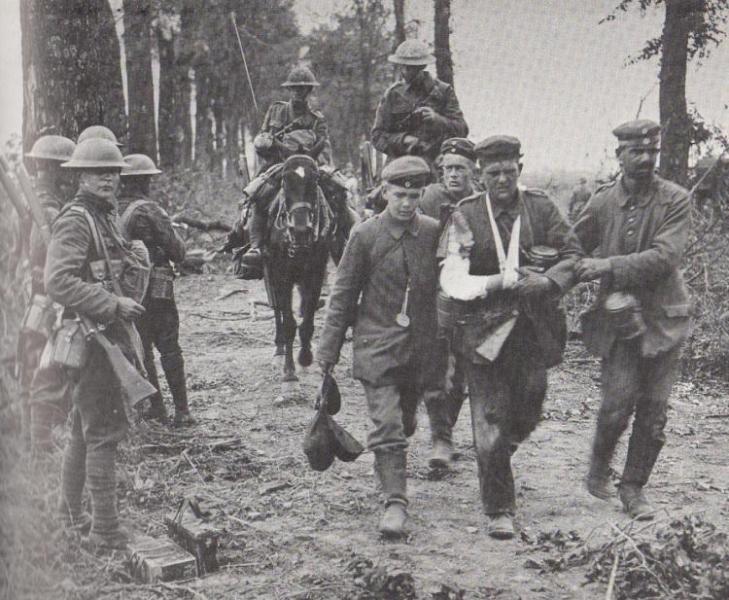
German prisoners are escorted by Canadian cavalrymen near Amiens. Library and Archives Canada Photo.

Frank was evacuated to Britain: first to the 4th Southern General Hospital in Plymouth on August 11, 1918, then transferred on Aug 22 to the Canadian Convalescent Hospital, Bear Wood, Wokingham, Berkshire where he recovered until discharged on October 4. At this point he was posted to the Canadian Reserve Cavalry Regiment in Shorncliffe where he stayed until the end of the war. On December 4, 1918 he was sent to Kinmel Park where he embarked for Canada on December 10. He was discharged January 23, 1919 in Winnipeg, where his wounds were assessed as well-healed, with no impairment or disability.  He was 20 years old.

Later that same year, Frank married Nellie Alice Hollingsworth who he must have met while stationed in England.  She arrived in Canada on July 2, 1919 with the words “to be married” stamped on the passenger manifest beside her name.  Frank and Nellie were married on July 29. In the 1921 Canadian census, Frank is listed as a farmer living just outside Winnipeg with his wife, his 1-year old daughter Joyce, his mother, and his maternal grandmother.  Although his mother is not listed as a widow, I could find no trace of Walter Beaumont Bester in the Canadian census from that year. As it seems that Alice passed away in England, it is possible that he had returned there as well.

Frank and Nellie had one more daughter, Jaqueline, in 1922.  In 1937, Frank, Nellie, and Jaqueline moved back to Britain, with Joyce following in 1939 all indicating that they would be residing in Essex. Jaqueline eventually returned to Canada to live, while Frank and Nellie both lived out the rest of their lives in England.  Nellie passed away in 1954 at the age of 58, and Frank in 1964 at the age of 65.


Ezekiel Gill

Ezekiel Gill, with his brothers David and William, formed a trio of Gill brothers that were in the British Expeditionary Force in France and Belgium. The second son of David and Louisa Gill, he was born on the 27th of December, 1894, just over 123 years ago, in the post-Christmas and pre-New Year’s period, just as we are in right now. In the 1911 census he is listed as still living with his parents, and working as a bottle packer at a glassworks.

On August 3, 1913, at the age of 18, he married Rosa Charlotte Kitchener, and very soon afterwards, they were expecting their first child. Their son, Ezekiel, was born in the spring of 1914, but sadly did not see his first birthday, passing away in early 1915.

Ezekiel’s military service record was destroyed among the other “burnt” service files, so we are left to piece together his service from other sources. Family documents shared with me by a Great Grand niece of Ezekiel suggest that he, like his brother David, first joined the Royal Field Artillery. At the very least, the family is fairly certain that he was present at the Battle of Loos in the fall of 1915, as his second child, David, born in December 1915 was given the middle name “Loos” presumably after this battle.

At some point after the fall of 1915, Ezekiel was transferred to the 1st Battalion of the Gloucester Regiment in the 1st Division.  His service between late 1915 and the fall of 1918 cannot be ascertained through the military record, although he must have had some time on leave as his wife, Rosa, was again expecting a child that fall.

In September of 1918, the Battles of the Hindenburg Line began in which the allied forces worked to break the defensive position the German forces had held since 1916. On the 28th of September, the men of the 1st Battalion of the Gloucester Regiment had baths in the morning, and by 5pm they had been ordered to move to the front to relieve the 2nd Infantry Brigade. The next morning marked the beginning of the Battle of the St. Quentin Canal.  The 1st Battalion was ordered to take and hold three strategic objectives, some of which were heavily defended by machine guns. The artillery was supporting them, but bad misty weather, heavy hostile shelling, and a great deal of noise made it difficult for officers on the ground to discern whether their artillery support was even there.

By midday, conditions improved, and the 1st began a creeping barrage toward their three objectives.  This was a gruelling series of hours with heavy artillery creating a screen allowing infantry to slowly advance 50 metres at a time. By dark, their targets had been captured, but at a toll of 55 casualties, including 8 men killed.  Among them was Ezekiel Gill.  He was 23 years old.

Ezekiel’s daughter, Rosa Louisa Gill, was born just over three weeks later.

Ezekiel is buried in Vadencourt British Cemetery in Maissemy, France.  I am honoured to share the CWGC commemorative certificate for my cousin here.


Herbert Arthur Gill

Herbert Gill, brother of Stanley, is the first Royal Navy serviceman that I will profile in this series.  Four years older than his brother, he first joined the Navy in 1911 at the age of 16 for a 12-year commitment, first at the training establishment HMS Ganges as Boy 2nd Class.  He worked his way through the ranks in his first three years through Boy 1st Class, Ordinary Seaman, then by the autumn of of 1914, Able Seaman at which time he was serving on the HMS Roxburgh. He would have been still serving on Roxburgh in June 1915 when she was struck and severely damaged by a torpedo from a German submarine.

HMS Roxburgh

HMS Roxburgh from naval-history.net

Herbert spent late 1915 and early 1916 at Vivid I, a seamanship, signalling and telegraphy School in Devonport. The rest of the war he was alternately at training and on HMS Colossus and HMS Hindustan.

Herbert was serving on the Hindustan was part of the Zeebrugge and Osten raids of April 23, 1918. The operation was intended to block the access of German shipping and submarines in and out of both ports. German submarines, torpedo boats and ships were based at the inland docks in Bruges and were using the Bruges shipping canal to access the English Channel via the two sea entrances at Zeebrugge and Ostend. The raids were considered successful, and several gallantry awards were presented as a result, including eight men being awarded with the Victoria Cross.

Herbert served with the Royal Navy until January 1925.

From there, I am not certain about the rest of Herbert’s life.  In my research, I have found at least three different Herbert Gills living in Edmonton all born around the same time between 1925 and 1950, and I haven’t found any conclusive enough evidence to identify any of them as this Herbert Gill.

Next week, another Gill–Ezekiel.

In the meantime, all the best to you for a lovely Christmas if that is your tradition! I will have a special post on the Facebook page on Monday, so please make sure that you follow me there as well.

Stanley Frederick Gill

Stanley Frederick Gill, like David Gill and William Jack Gill, is my second cousin four times removed.  We are all descended from John Gill and Elizabeth Munns, but where David, William  and their brother Ezekiel (who I will profile at a later date) are descended from John and Elizabeth’s son Jack, and I am descended from their daughter Sarah,  Stanley and his brother Herbert Arthur, who I will profile next week, are descended from their daughter Alice Gill.

Family tree

Abbreviated family tree showing my relationship to two other branches of the Gill family.

Alice Gill had two children before she was married, a daughter, Elizabeth, presumably named for her mother, who died at the age of two, and William John. William was six years old when his mother married Stephen Farrington in 1869.  Alice and Stephen went on to have five more children together.  By the 1891 census, William is listed as living with his wife, Emily, and their daughter Nellie on Bury Street in Edmonton, North London.  Interestingly, he didn’t stray far from home as his mother and step father lived on the same street, as did his aunt (and my 4th Great Grandmother) Sarah and her family. By 1901, William and his family had moved to Osman Road, still in Edmonton with their growing family.  William and Emily had a total of twelve children between 1889 and  1910, five of whom did not survive past infancy.  William died in early 1914, just before the world descended into total war.

Stanley Frederick Gill was 15 when his father, William, died, and only 17 years and 10 months old when he attested to the King’s Royal Rifle Corps on December 16, 1916, one hundred and one years ago today.  He was listed as the “head” of his household at the time. In March 1917, roughly a month after his 18th birthday, he reported for his medical inspection and spent the first part of his service in a King’s Royal Rifles Corps training battalion located in Canterbury.

In the fall of 1917 he was hospitalized twice for scabies, a parasitic skin condition that afflicted thousands of men in the close quarters of military camps and training.  He found himself in a spot of trouble in early 1918 as he was discovered absent from the morning of January 10, 1918 to the next morning, and was confined to barracks for three days as a punishment. Whatever his reason for being absent, given what was to come for him over the following months, I hope it was for something that gave him a pleasant memory to look back on.  He was hospitalized once more for scabies from the 26th to 28th of January.

He embarked for France February 3, 1918, one day after his nineteenth birthday, being deployed to the 7th King’s Royal Rifles in the 14th Division. He had only been with the battalion for a short while, when, at 4:45 am on the morning of March 21, everyone was awoken by the sound of what was described in the war journal as “a very heavy enemy barrage.” This barrage cut communications between headquarters and the front line, then, morning greeted them with a dense fog with visibility down to 50 yards.  These were less than ideal conditions for a coordinated response to what would be one of largest German offensive efforts of these later days of the war.  This battle, known as the Battle of St. Quentin, was the beginning of the First Battles of the Somme, 1918.

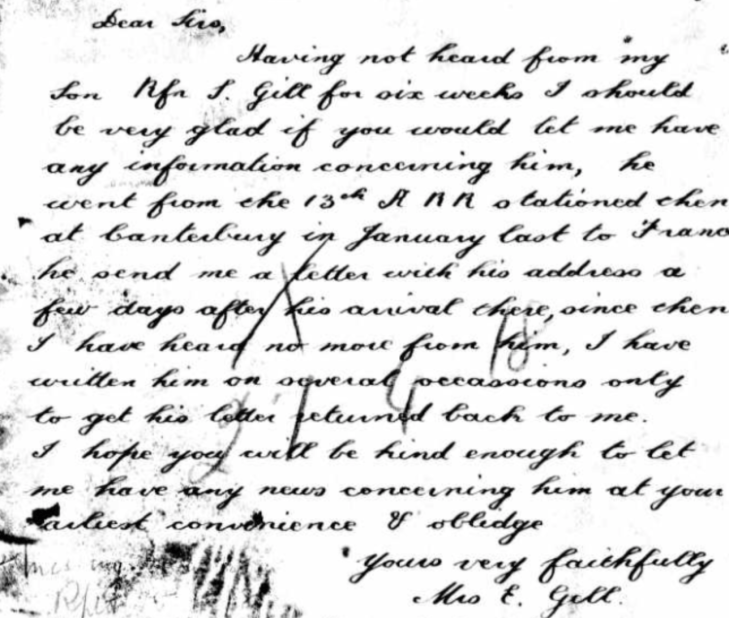
The war diary reported that 250 “ordinary ranks” from the 7th King’s Royal Rifles were killed, wounded, or went missing on March 21.  One of these men was Stanley. Throughout April of 1918, his mother, concerned after not hearing from him for several weeks, was trying to get information on his location.

Mother's letter

Excerpt from letter written by Emily Gill on the subject of her son, Rifleman Stanley Gill.


Stanley was one of several men who had been taken prisoner that day at St. Quentin. The International Committee of the Red Cross’ archive of Prisoners of War places Stanley first at the Stendal POW camp, then at the Neuhammer POW camp.  By all accounts, life in these camps was, at best, cramped and uncomfortable with days filled with hard labour, at worst, cruel and humiliating including being paraded in public at cinemas and train stations in order to underscore the strength of the captors.  But this said, there was massive infrastructure at these camps including a camp-specific currency that could be used to purchase items at a commissary.

Camp

Barracks at Camp Stendal

The repatriation of Prisoners of War was one of the items covered in the armistice.  Generally, British prisoners were re-patriated very quickly.  By March 1919, Stanley was back in Canterbury.  He was hospitalized again, this time for diarrhea–another very common complaint among soldiers. He was then posted to the Rifle Depot at Winchester.

Stanley was demobilized in February 1920.  He was barely 21 years old.

He married Ada Goulding in 1926 and they went on to have three children.  Stanley passed away in 1961 at the age of 62.


Emma Maud Law and George Harris

CalltoWomen

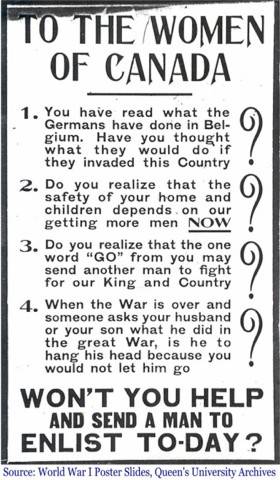
Poster directed at Canadian Women

At various points throughout this year, the soldier I will profile will not be my relative, but rather the spouse of a relative.  Given much of my initial interest in the Great War was based on homefront life and how the war was being communicated through popular media of the time, it’s important to me to examine at least a few of these stories through the perspective of the women who were left behind when their husbands, fathers, brothers and sons left home for extended periods of time.

To date, all the relatives I have profiled have been from my maternal grandmother’s side of the family, a branch of my lineage that are 20th century transplants to Canada, having arrived in a post-confederation dominion already joined coast to coast by rail.  On the other hand, my paternal grandfather’s family arrived in an early colonial Canada still being shaped by conflicts between France and England on the other side of the Atlantic, and where the European settlement west of the Hudson’s Bay was largely focussed on the fur trade.

Emma Maud Law is the first of the relatives from my this side of my family I will be profiling. We are both descended from Francis Joseph Langton (1814-1888) and Sarah Bishop (1821-1887). The Langtons arrived in Upper Canada (later Ontario) sometime before 1825, and the Bishops sometime before 1847 which was the year Sarah married Francis in Newmarket.  This couple later settled in Peterborough (which interestingly continued to figure prominently in my family’s history, as it was here that my parents met and married a century and a quarter later). Francis and Sarah had 11 children, one of which being Emma Maud’s mother, Martha Jane (born 1852), and another being my 2nd Great Grandmother, Ada May Langton (born 1858).  

Emma was the youngest child of Martha Jane Langton and John William Law making her my 1st cousin 3x removed. Born in 1888, Emma was born into a largely industrial town that was Ontario’s largest producer of timber at the time. By 1901, the family was living in Cardinal, Ontario, a small industrial community east of Toronto where Emma’s father was listed in the census as a machinist. By 1910 the family had moved into Leslieville, a largely industrial east-end part of Toronto with a concentration on tanneries and metal working. 

Made by Samsung DVC

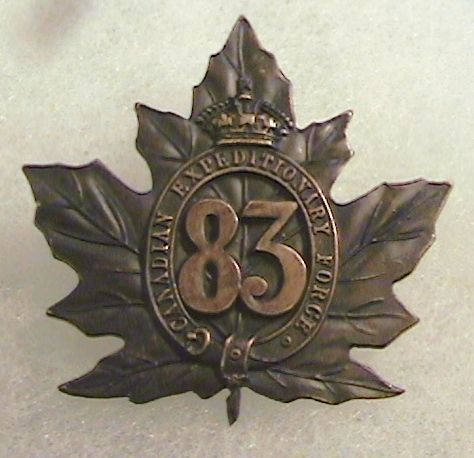
Badge of the 83rd Battalion, Canadian Expeditionary Force

It was here that Emma married George Harris in 1910. George was a recent immigrant to Canada having arrived only four years earlier from England. His sister and her family had also recently immigrated, and they all settled in the east of Toronto.  In the 1921 census, George ‘s trade or calling is listed as “bricklayer.”  George attested to the 83rd Overseas Battalion in August of 1915, and his brother-in-law, Charles Pentney did the same in November of 1915.

The 83rd was broken up soon after arriving in England in the spring of 1916, and used to reinforce other CEF units.   George was one of 498 men from a variety of reserve battalions sent to reinforce the 4th Canadian Mounted Rifles. This unit was part of the Canadian effort at the battle of Fleurs-Courcelette as part of the 1916 Somme offensive, the April 1917 Vimy Offensive, the October 1917 Passchendaele battles, and many more with the 4th CMR becoming one of the most celebrated battalions in the CEF.

Meanwhile, in Toronto, Emma was living in a city consumed by the war effort. As a main transportation hub, thousands of soldiers were coming through the city as they were on their way to ports like Montreal or Halifax for transport to England.  Thousands more were based out of Toronto for their training, and the city transformed to accommodate this reality.  University campuses became camps, the Canadian National Exhibition Grounds became a recruitment and training centre, parks were used to simulate battlefield conditions, and parades to drum up recruits and financial support for the war in the form of Victory Bonds became commonplace on major streets.  Industrial business owners transformed their operations to support the war effort.  I have very little information on Emma’s life during the years George was overseas other than the record of her separation allowance being paid.  She and George had no children, but with George’s sister nearby whose husband was also overseas, and a sister of her own outside of Toronto with a husband overseas, I like to think that she was not utterly alone.

The 4th CMR finally returned to Toronto in March 1919.  The Toronto Star described in detail the scene as these men were received home including how the “YMCA lady helpers never had an idle moment.  They were busy all the time preparing the eats for the boys. When the boys did arrive, the ladies stood at attention and made a pretty picture in the glare of the electric lights.”

In the 1921 census, George had been unemployed for 12 months, not an unusual state for returning soldiers, as the immediate post war economy had high unemployment and inflation (both of which contributed to labour actions such as the Winnipeg General Strike of 1919). In February of 1923, Emma died due to complications from Influenza.  It appears that she had been ill for a long time as there is a list of chronic conditions also listed on her death certificate. George passed away in Toronto in 1968 at the age of 82.