Joseph James Foster-Part 2

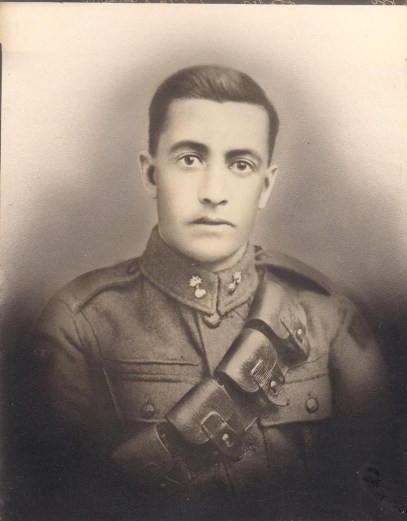
Joseph James Foster, 1916.

By January of 1919, Joseph had been away from his family for two and a half years and had been in France and Belgium for some very brutal parts of the war. There was no record of him ever having been injured or sick, not even the very common ailment of scabies.

In the months after armistice, the armies found themselves with a tremendous amount of personnel, equipment, and animals scattered throughout Northern France and Belgium that needed to be reorganized and reassigned, and in several cases there was also a great deal of infrastructure that needed to be repaired in order to facilitate that level of movement of people and machinery.

In the case of troops from overseas, there was also a tremendous backlog in terms of determining how and when to get men home.  This resulted in battalions with a lot of time on their hands, attending dances, organizing sports activities, parading, and then performing light duties as needed.

The entry for the 12th Engineers on January 27, 1919 in the war diary is almost identical to the days that preceded it and the days that followed it.  They had been in Belgium since armistice, and there was no sign of them moving significantly anytime soon.  The Battalion built a boxing ring that day… this is the only thing of note. But for my great-grandfather, that day was the start of a dramatic few months that would precede his returning to his family in Toronto.

He went missing from his billet that evening, and would not return until January 31st, nearly four full days (3 days and 22 and a half hours to be precise), at which point he was arrested by the Regimental Sergeant Major for being absent without leave, and, more seriously, for stealing a horse belonging to the government and selling it.

The stable master had discovered a horse missing on the night of January 27th, and quickly organized a search party to look for the animal.  They found the horse in question that same night, and woke the man on whose property the horse was found to piece together what had happened.  According to the statement provided by one of the men who had been part of the search for the horse and who was present when the civilian who had bought it was describing the events, the civilian stated that he had been sold the horse by two Canadian soldiers:

He described one was being French-Canadian and the other as a short, dark man who he thought was a cook.

This short, dark man matched the description of Joseph James Foster. Although there is no direct mention of cook’s training in his service file, there are several mentions of men being sent for cook’s training after the 124th disbanded and was dispersed.  Unfortunately the parts of the court martial file with Joseph’s verbatim statements are too faded to read, but the word “cook” is legible on one page.

He was held in confinement for 29 days before his trial on February 28, 1919.  He and another soldier, Dvr. A. Jobin, a French-Canadian soldier, were accused of stealing a horse from the stables of the battalion on the evening of January 27th, and then selling it for 700 francs to a nearby civilian. Both men pleaded guilty to being absent without leave, but not guilty to the charge of stealing the horse.  Evidence against him included the statements of all the men who had assisted in finding the horse, as well as his previous punishment from October of 1917 when he had been found drunk on active duty, and had been given 14 days worth of “field punishment No.1.”  This punishment, nicknamed “crucifixion” by many soldiers, entailed labour duties and attachment to a fixed object such as a post or wheel for two hours a day.  According to the Canadian War Museum’s page on discipline and punishment, this was considered a particularly humiliating and degrading practice.

Despite their plea, both men were found guilty on both counts and were sentenced to four months in military prison.   The convictions and sentences from the field court martial were upheld on review by a judge, and Joseph was sent to military prison in March of 1919. It appears that he served his full four months sentence, as it wasn’t until July of 1919 that he finally boarded a ship for his return to Canada, landing in Halifax on July 23, 1919, just a few days under three years from when he sailed for Britain.  Three days later, he was back in Toronto, where he was officially discharged from the Canadian Expeditionary Force.

Joseph went to work as a postal clerk, and by early 1920, he and his wife Mary Alice, were expecting their third child.  This baby, a boy, was born in November of 1920, and he was named Joseph James after his father.  This baby was also my Grandfather. Six years later, another baby, a daughter, was born.  Joseph was 41 at this time.

By late 1937, 51-year old Joseph was in sales with a dairy.  At least one of his sons was also working as a dairyman.  His two older sons were 26 and 23 respectively.  The eldest was married with a son of his own, and the younger was engaged. Joseph’s two younger children were 17 and 10 respectively.  On November 10, 1937, Joseph took some sheets and tied them to a bannister, then around his own neck.  He was 51 years old.

Family lore says that it was my Grandfather, Joseph James Jr., who found him.  His record of death states that he died of strangulation by way of suicide. My Grandfather’s oldest brother was on record as the informing party.

Soldier suicide after the great war has not been widely studied, but it has been fairly universally acknowledged that this war had a profound effect on the mental health of many of the people who participated.  This is a phenomenon that we recognize much more broadly today, and supports and treatment are available. I have no way of knowing what specific series of events or state of emotional health contributed to my Great-Grandfather’s death in 1937.  All I know is that he passed away in a very sad manner, and that it is very possible that he had been deeply impacted by what he experienced between 1916 and 1919.

My great grandmother, Mary Alice Pickering, married again in 1938 to widower Elias Williams. The following year, the world was engulfed in war again, and the pattern I have been tracing for the past year began to repeat itself.  My Grandfather, Joseph James Foster Jr. enlisted in 1941, soon after marrying my Grandmother, Florence Elizabeth Miller.  My Grandmother’s father, John Russell Miller, had also been in the Great War.  Her brother, Samuel, was already overseas in the RAF when she married my Grandfather. In 1942, Samuel was shot down and killed. My Grandfather, however, did make it through the war, and returned in 1946 ready to resume his life as a salesman with CIL paints, and begin his family life with my Grandmother in earnest.

Tomorrow, I look forward to being able to share this story and the stories of the 51 other men in this series at the Armistice 100 events here in Edmonton, Alberta.  It has been an honour to share these stories over this past year.  I am looking forward to the next evolution of this project, which I will share more about in the weeks and months to come.


Update: Edward Clinton Biccum and Nellie Richmire.

One of the most rewarding parts of this project has been connecting with distant relatives, and making connections across the country and the world about our common relatives.  This past week, the great-grandson of Edward Clinton Biccum and Nellie Richmire reached out to me to ask if I would add some additional information to the story of his grandparents that I first wrote about last February.

My post ended by referencing Nellie’s remarriage after the war to a man named Frank Brant, and that Nellie, her and Edward’s son, John (Jack), and Frank settled in Michigan.

Nellie’s grandson wrote to me that Frank Brant was also veteran of the Great War, having served as a private in the United States Army with the 42nd Infantry Division from November 1917 until the end of the war.  He survived the war, but it clearly had it’s impact.  As my distant cousin wrote to me last week, “when the United States entered World War Two, Frank strove to find my grandfather a war-essential job, so that Jack wouldn’t have to experience war as he did.”

This week, leading up to Remembrance Day, I am so honoured to remember the men in this project through events such as the anniversary of armistice, but also to remember the families of those men and the impact that the Great War had upon them well after November of 1918.  We are still feeling the impact of all of these families’ experiences today.

Joseph James Foster-Part 1

Joseph James Foster was my great-grandfather, and the 52nd citizen soldier I am profiling in this series.  On his mother’s side, he was descended from the Langton and Bishop clans, both of which arrived in then Upper Canada in the early 1840s. This is a line of my paternal family I have documented in 6 other posts this year.  His father George Whitfield Foster, along with his parents William Foster, a draper from Manchester, and Jane Kirkman immigrated to Canada from England in 1871.  George, who became a painter (I assume of buildings) married Ada May Langton in 1880 in Peterborough, ON.  By 1891, George, Ada, and their 6 children (their 7th and youngest child was not born until 1896), including my great grandfather Joseph, were all living in the same home in Toronto.

By the 1901 census, William and Jane were no longer living with the family, and 16-year old Joseph is listed with the occupation “driver.”  In 1910, he married Mary Alice Pickering, the second youngest of 10 children in the Pickering clan.  He was 24, and she was 18. Joseph and Mary Alice had two sons before the war, Gordon and Earl Edwin, who were five and three respectively when Joseph signed his attestation papers in January of 1916.  He was a short man, 5’2″, with dark brown hair and blue eyes. Thelittle finger on his right hand had been amputated in 1909 after being severely burned in an accident when he was working at a brick yard, but this did not prevent him from being considered fit for duty.

Joseph enlisted in the 124th Battalion (later the 124th Pioneer Battalion) of the CEF which trained in and around Toronto before finally sailing to Britain in early August of 1916. Training continued in England between August of 1916 and March of 1917.  On March 9, 1917, the battalion sailed for France, landing in Boulogne. Their first month was predominantly spent digging trenches, laying communications cabling, and working on ammunition dumps.  On April 9, 1917, after only one month in France, the war diary for the unit states:

Weather continues unsettled and condition of ground very muddy. Parties are very fatigued but are continuing work uncomplainingly, and cheerfully.

Not only was the work being done through difficult environmental conditions, but the battalion was also under fire or being shelled during much of their work, with members of the battalion being injured or killed on nearly a daily basis. This work must have seemed thankless, though we now recognize that all this digging and cable laying in the spring of 1917 in this part of Northern France was instrumental to success of the Canadian troops at the battle of Vimy Ridge from April 9-12.

By the fall, it can be imagined that this level of work would be taking its toll.  Joseph had only had one break from the field on record in this time: 7 days at the 1st Army Rest Camp where he was still on duty, but could have been participating in other activities.  At some point in early October, he was caught drunk while on active duty, and punished. By mid-October, the 124th battalion was in Belgium at Ypres. The account of the autumn there is brutal: continual attempts to build and rebuild roads and shelter just to have them shelled when they are nearly complete.  By late November, the battalion had moved back to Northern France further back from the front lines to engage in training. On December 22, Joseph was granted 14 days leave to Troyes, which is where he spent Christmas of 1917.

Joseph returned to the unit on January 5, 1918. At the end of May, 1918, the battalion was broken up and dispersed among the 10th, 11th and 12th battalions of the Canadian Engineers.  Joseph landed with the 12th battalion.

Joseph’s first few months with the Engineers does not seem to be as intense or dangerous as his time with the 124th. By mid-August, however, the battalion was in full support of the final push of the war. By November 11, 1918, the battalion was close to the border between Belgium and France, and was ordered to march east toward Germany.  Joseph was granted leave to England from November 23 to December 14, and he rejoined his unit at Ransart, Belgium, and they continued their march east. By Christmas, they were at Longueville, Belgium, and there they had a Christmas dinner consisting of “turkey, vegetables, plum pudding, fruit, nuts, tea and beer, and afterwards a substantial issue of rum.”

In January, the battalion moved in to Brussels, and seemed to be in a holding pattern, spending a great deal of time playing football and practicing football.  In was in this environment that Joseph found himself getting in to trouble.  I will continue with his story in my next post in a couple of days.  Until then…

Harry Willie Edward Dodd

Harry William Edward Dodd was my first cousin three times removed.  We are both descended from Francis Joseph Langton and Sarah Bishop who were my third great grandparents, and Harry’s Grandparents. As a refresher since it has been a while since I wrote about this branch of my family, the Langtons arrived in Upper Canada (later Ontario) sometime before 1825, and the Bishops sometime before 1847 which was the year Sarah married Francis in Newmarket.  After settlings in Peterborough, ON, Francis and Sarah had 11 children, one of which being Harry’s mother, Sarah Ellen, and another being my 2nd Great Grandmother, Ada May Langton.

Sarah Ellen married John J. Dodd, a barber, in 1875 in Peterborough at the age of 22. Two years later, Harry was born, and he grew up in Northumberland county, just south of Peterborough. He grew up here, and began work in the tannery in Cobourg, which was a significant industry for the town. In 1897, he married Mary Eliza Raycroft, and the two started their family in Hastings, Ontario, still in Northumberland county. By the time the war began in 1914, Harry and Mary had eight children, one son, and seven daughters.

Harry enlisted in the 139th overseas battalion of the CEF in January of 1916 when he was 38 years old. After training, he sailed for England in September of 1916, and on arrival was transferred to the 36th Battalion, then again to the Royal Canadian Regiment before being sent to France in late December of 1916. The conditions he arrived to were atrocious. For the day he arrived with the regiment, the war diary states:

Very heavy rainfall. Deep dug-outs leaking, trenches in very bad condition, sides caving in, flooding C.T.s and Front Line. This is due to taking over unrevetted trenches with no Draining System. This work should have been done in the summer months.

Harry was with them for 15 months in France, which happened to coincide with 15 of the most active months for the RCR.  During this time, they were actively involved at Flers-Courcelette, Vimy, Hill 70, Ypres–some of the most intense battles of the war. In early 1918, Harry was sent back to England due to some generalized complaints about pain and nervousness.  He claimed he couldn’t march more than 1 mile, or walk more than 3.  His medical board report states that he has some generalized discomfort, and that “patient appears nervous.”  He was diagnosed with slight “disordered action of the heart.”  I am not a medical professional, but I can’t help but wonder if what Harry was suffering from was panic attacks.

Harry served the rest of the war in England with a service corps team.  He was again reviewed by the medical board before discharge, and was again recorded as being nervous with an inability to stand still, but nothing that indicated his military service would interfere with his ability to work upon return home. He returned to Canada in March of 1919. In the 1921 census, he is listed as living in Hastings with his family and working as an “agent.”

That 1921 census entry makes me sad.  It is so normal.  I know a census is not meant to me a narrative history of a person, but it still feels mean somehow that it doesn’t take into account the three year separation from his family, the experiences he had while away, and the impact it may have had over the two years since he was home. It embodies the expectation that things would return to normal.  He, I suppose was considered one of the lucky ones given that there were so many other young men from southern Ontario who didn’t return at all. Harry passed away in 1951 at the age of 74.

There is only one more entry left in this project, the 52nd David, my Great Grandfather Joseph James Foster.  I am taking some time with that post, and it may or may not appear next weekend, I may decide to post closer to the centenary of armistice the following weekend.  Until then!

Emma Perring and Frederick William Dyson

Emma Perring was my first cousin four times removed.  We are both descended from James Perring and Emma Law who were my 4th Great Grandparents, and Emma’s Grandparents.  As I detailed in earlier posts on this branch of my family, at some point between 1841 and 1851, James and Emma Perring and their family were committed to the Saffron Walden Union Workhouse.  In the 1851 census, the couple and four of their children are listed as “inmates” at the facility.  Charles, Emma’s father, was born in 1855, so it is possible that he was born at the workhouse, or soon after the family left.  At any rate, by the 1861 census, when Charles was 5, the family’s fortunes had improved enough that they were living in their own home, with James and his three oldest sons working as agricultural labourers, and his daughter Mary working as a house servant.

By the 1871 census, Charles, like his father and brothers was also working as an agricultural labourer, and three years later, at the age of 19, he had left Essex, and married Sophia Elizabeth Gray in London, after which they settled in Clapton in the east London borough of Hackney where Charles worked as a coachman and a groom. In 1876 Emma Sophia was born, the second child born to Charles and Sophia.  By 1891, Emma was no longer living with her parents, which I suspect means that she was a live-in servant elsewhere by the time she was in her mid-teens.  This would be consistent with her sisters Florence, Edith, and Daisy, all of whom were in service at some points as young women.

In 1903, at the age of 27, she married Frederick William Dyson, also 27, in Paddington.  Frederick worked as a milk carrier for a dairyman. They had two sons, in 1906 and 1908 respectively.

Frederick’s war records are not available, presumably burnt; therefore, I don’t know exactly when he enlisted.  He was a member of the 15th battalion of the Worcestershire Regiment, which was formed in late 1916, and was a transport battalion that spent the war in England, mostly in Southampton.  Frederick was a Lance Corporal with the unit, so had some leadership responsibilities.  The records I do have state that he died at the University War Hospital in Southampton on October 21, 1918, one hundred years ago this past week.  He was 41 years old: the same age I am now. I do not know whether there was an accident or an illness that resulted in his death, but the result was that my cousin Emma lost her husband, and she was left, also at 41, with her two young boys.  Emma lived the rest of her life in Paddington and passed away in 1939 at the age of 62. I am honoured to post the Commonwealth War Graves Commission commemorative certificate for my cousin’s husband here.


Edwin George Mungham

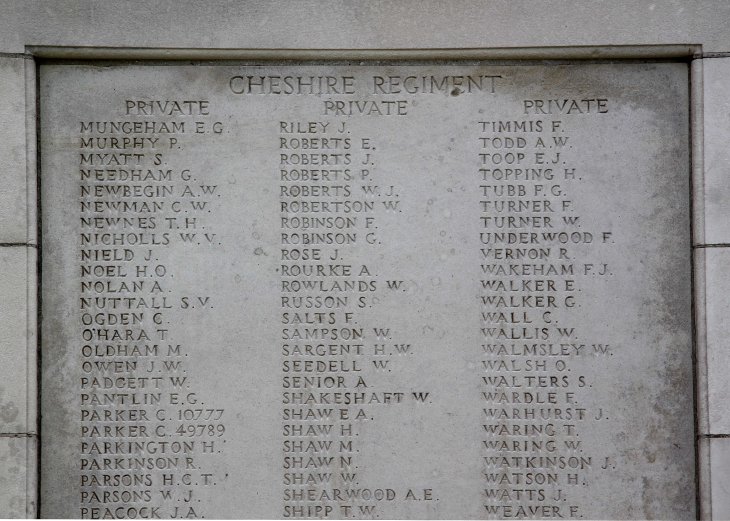
Edwin George Mungham (or Mungeham) was the older brother of Frederick Thomas Mungham who I wrote about late last month. Four years older than his brother, Edwin bucked the trend of many of his family with a much more white collar job than those who were in the brickfields in Kent, and worked as a government porter in London. He was married in 1910 to Sarah Dunn, and at the time of the 1911 census, they were living in Lewisham.

His records, like his brother’s, were burnt, so I do not know precisely when he joined the war effort, but, regardless of his enlistment date, from the earliest points of the war, he would have been impacted due to his brother’s death in Belgium in the fall of 1915. His father, Edwin Sr., passed away in June 1918, adding another sorrow to his lot.

By the fall of 1918, the 15th Battalion of the Cheshire Regiment was part of the final offensive of the war.  In Belgium, a series of liberating battles were being fought as the German forces were pushed further and further east by the creeping barrage style fighting of the allied forces.  The morning of October 14, 1918 saw the beginning of the Battle of Courtrai, and the British forces advancing at a pace of 100 yards per minute.  The war diary for the battalion said that:

…too much credit cannot be given to the men who though tired out and suffering of exposure, rose to the occasion, and put up the best show ever given by the Battalion.

Between the 14th and the 19th, landmark after landmark was gained by the British, and this major part of the offensive was a significant part of the 100 days push at the end of the war.  Edwin, as part of “the best show ever given by the Battalion,” was killed in action on October 14, 1918.  100 years ago today.

Edwin, and many others from the Cheshire Regiment, are memorialized at Tyne Cot Memorial in Belgium.

Mungeham Tyne Cot (1)

I am honoured to share the commemorative certificate from the Commonwealth War Graves Commission for my cousin here.

Thomas George Henry Newbury

Thomas Newbury was my first cousin four times removed.  We are both descended from Sarah Gill and Charles Bester who were my 4th Great Grandparents, and Thomas’ Grandparents. I am descended from their third child, Annie, while Thomas is descended from their 6th child, Caroline.

22-year old Caroline Bester married 28-year old widower George Newbury in Edmonton, Middlesex in 1887.  George had lost his wife the previous year, and had two sons, ages 6 and 8.  Five additional children were added to this family between 1888 and 1899, the youngest of which was Thomas.  George Newbury died in 1904 leaving Caroline with five children still in her care from ages 5 to 17.  Her two stepsons were by this time independent.  After four years on her own with the children and seeing her eldest daughter marry, Caroline decided to emigrate with her children, Millicent, William, Annie Constance, and Thomas, to Canada to join her sister Annie (my 3rd Great Grandmother) and her family, who had made the move to Canada the year before.

Caroline and her children, like Annie’s family, settled in Orillia, Ontario, a place where I still have many relatives to this day. Two years later, her daughter, Elizabeth, her husband, Harry Allinson, and their four year old daughter also joined the family in Orillia, and the Allinsons and Newbury families combined households.  Sadly, Elizabeth died soon after giving birth to her second daughter in 1911 due to eclampsia. Millicent Newbury,  like her sister, also had a daughter in 1911, but under very different circumstances.  At the time of the 1911 census, she and the baby were both living in York, Ontario (now Toronto) at Redemption House, a home for women “tired of a life of sin.”  William Newbury had also at this point moved to York, and would eventually relocate further south to the U.S. All in all, 1911 was a difficult year for the Newbury family.

The following years would see a stabilization for the family.  In 1912, Caroline married widower John Henry Coleman Armstrong with whom she would live out the duration of her life.  Annie Constance moved to York and married that same year.  Millicent returned to Orillia with her daughter, and in 1914 married a man who adopted her daughter and with whom she had 3 more children.  Thomas became an apprentice printer.

In June of 1916, at 16 years and 9 months of age, Thomas attested to the CEF and in July of 1916, he sailed from Halifax for England with the 116th Overseas Battalion. He trained at Hastings and Bramshott before being posted with the Canadian Military Hospital in Bramshott.  Throughout the rest of the war he trained with the “boy’s battalion” or the “young soldiers corps,” but he never left left England.  The entirety of his time overseas was in England.  He was among some of the first Canadian soldiers returned to Canada in late November of 1918.  He had just turned 19 the previous month.

In 1921, Thomas married Alice Edith May Latham in Toronto.  He and Alice had 5 children.  Thomas died in 1948 at the age of 48 in Bath, Ontario.

Mr. John Babcock, the last surviving Canadian Veteran of the First World War who passed away in 2010, was also part of the Young Soldiers Corps.  He describes his experience in that corps here.