George Arthur Saggers

George Arthur Saggers was my first cousin three times removed.  We are both descended from Henry John Mungham and Eliza Francis Ing who were my third great grandparents and George’s Grandparents.  Henry and Eliza were both born in Kent to families making their living in brick making. They married in 1871 when Henry was 24 and Eliza was 18. They lived at least the first 12 years of their married life in Kent where Henry also worked as a brick maker, and where they were living when their first five children were born, including my 2nd Great Grandfather, Harry, and George’s mother, Rosetta.

Sometime between 1883 and 1886, the family relocated to Essex, where Henry (as well as my 2nd great grandfather Harry) continued his trade in brick making.  Henry and Eliza went on to have 5 more children in Essex.

Born in 1877, Rosetta Mungham was the third child of Henry and Eliza.  She is not listed as living with her family at the time of the 1891 census, at which time she would have been 14, so it is possible that she had taken work as a servant in her youth.  In 1899 at the age of 22, she married Alfred George Saggers a general labourer from Essex, and their first child, George Arthur, was born the following year.

Being born in 1900, George was too young to join the war effort at its outset, but in the summer of 1917, 17 year old George enlisted in the Royal Navy for the duration of the war.  Hi occupation at the time was listed as an engine cleaner, and his rank was a stoker.  He trained at a shore establishment in Devonport (Plymouth), and on December 6, 1917, he was assigned to HMS Aurora, a fairly new Arethusa Class light cruiser.

HMS Aurora

HMS Aurora

Aurora had already see her fair share of significant action in the war, taking part in major battles and the sinking of some significant targets. In 1918, soon after George would have been assigned to her, she was reassigned to the 7th Light Cruiser Squadron of the Grand Fleet.  HMS Aurora was one of the ships present at the surrender of the German High Seas Fleet, in November 1918.

The role of a stoker was one of the most difficult and thankless of the Navy.  As is outlined in a 2013 PhD thesis for the University of Exeter, stokers were regarded as the lowest class of men, yet without them, the great ships of the fleet would never have left port.

George served aboard Aurora until March of 1919, and there is little record of his life after the war.  He passed away in Essex in 1966 at the age of 65.


Joseph Jean Baptiste Thivierge

I have been thinking about this post for a long time.  This, along with the post from earlier in this series on Wilfrid Lacasse, is one of only two posts from my maternal Grandfather’s side of my family, which, interestingly, I have the most genealogical background on both from my research through Ancestry as well as through work that has been done on family history by a number of different distant relatives throughout the years. This part of my Canadian pedigree can be traced back to my 8th Great Grandmother, Marie Helene Desportes, who was according to some reports the first child of European descent born in  New France (now the Province of Quebec). Born in 1620, she married twice and had fifteen children, one of whom, Marie Morin, married Gilles Rageot, a recent arrival from France, in 1673. From here, the Rageot (later Rajotte) family spread in French Canada, then eventually also into western Canada.  My Grandfather, Albert Rajotte, was fascinated by this family history, as are many descendants of the Rajotte lines.  That said, it is the branch of my family history with the least evidence of direct participation in the Great War.  There may be many reasons for this, but, as I wrote in the entry on Wilfrid Lacasse, I suspect that at least in part, this is due to the fact that the war was not part of the French Canadian consciousness in the same way that it was in English Canada.  This was related to the fractious relationship with British Imperialism in French Canada as well as to the sense that, as this fantastic article from the Canadian War Museum states: “neither France nor Britain was “a mother country” retaining the allegiance of French Canadians. The “patriotic” call to arms rang hollow.”  Attempts were made through a variety of means to appeal in different ways to French Canada’s interests, including the poster below blatantly appealing to the connection between French culture and Catholicism, but enlistment would never reach the pace it did in English Canada.

French Canadian recruitment

Recruitment poster directed at French Canadians: loosely translated: “Are we waiting until it’s ours that burn? Let’s join up, and right away.”

The Canadian government’s 1917 reversal of a previous promise to never conscript men into military service also hurt the relationship with French Canada. Demonstrations at the Military Service office in Quebec City turned to a deadly riot in March of 1918, with English troops opening fire on French protesters.  These wounds between what Hugh MacLennan later famously called the two solitudes would not easily heal, and in some very real ways, still haven’t.

Joseph Jean Baptiste Thivierge, my 2nd cousin 2x removed, was one of these French Canadian conscripts.  He was not connected to the Rajotte line, but rather to the Monette line, my Grandfather’s paternal grandmother’s line.

Thivierge

Abbreviated family tree of descendants of Elmire D’Amour and Auguste Monette

Joseph was born in 1895 in Hull, Quebec, to Jean Baptiste Thivierge and Adelia D’Amour.  By the time Joseph was called up under the Military Service Act to join the 2nd Depot Battalion of the Eastern Ontario Regiment, it was May of 1918.  He was 22 years old, and an accountant, still living in Hull.  His mother, Adelia, was listed as his next of kin.  He trained throughout the summer, and was transferred to the 2nd Canadian Tank Battalion in September of 1918. On October 4th, 1918, he sailed from Halifax for England, arriving on October 18th.  On November 11, hostilities ended, and Jospeh, never having left England, re-embarked for Canada eleven days later, arriving on November 29.  He was discharged from the service on New Year’s Eve 1918.

While in retrospect, it is clear that Joseph would never see the western front, and his voyage to England and back is almost comically short, he had no way of knowing that he wasn’t going to find himself inside a tank in France. For nearly six months, he was training for, and even shipped overseas in preparation for, a war he did not sign up to fight. I can’t imagine how frightening and frustrating this may have been.

Joseph married Alice Sauve in 1919, and they went on to have two children.  Joseph passed away in Hull at the age of 64 in 1960.


Ernest James Perring

Ernest James Perring was my first cousin four times removed.  We are both descended from James Perring and Emma Law who were his grandparents, and my 4th great grandparents.  James Perring was an agricultural labourer who lives the entirety of his life in Essex.  He and his wife Emma had twelve children of whom I could find record: one daughter and eleven sons.  Of these sons, one was my third great grandfather, Walter Perring; one was Joseph Perring who lied about his age to enlist in the war and whose sons, Edmund and Alfred, have also been part of this project; and another was James Perring, Ernest’s father.

Ernest James Perring 2

Abbreviated family tree of James Perring and Emma Law


At some point between 1841 and 1851, James and Emma Perring and their family were committed to the Saffron Walden Union Workhouse.  In the 1851 census, the couple and four of their children are listed as “inmates” at the facility, including three year old James. Fortunately, this wasn’t a permanent situation for them, and by 1861, the family’s fortunes had improved enough that they were no longer in the workhouse.

By the 1871 census, James had married his first wife, Mary Ann Wilkinson, and was working as an agricultural labourer.  At some point in the following several years, his first wife died, and in 1878, he married Mary Ann Palmer with whom he raised his two children from his first marriage as well as the five that they had together.  By the 1881 census, the family had relocated to Edmonton, Middlesex (London area), and James was working as a “platelayer” which was a railway employee whose job was to inspect and maintain a section of track.

Ernest was born in Edmonton in December of 1883.  By the age of 18 he was working as a clerk, and in 1909, at the age of 25, he married Ada Isabel Cresswell.   Four children soon followed, as did a change of career, as by 1917, he is recorded as being a “steam bus driver.”  Steam busses were common in London and elsewhere as a form of transportation.  This experience served him well, as in 1917, he enlisted in the Royal Navy as an Air Mechanic.  Upon the formation of the Royal Air Force on April 1, 1918, he was transferred into their service, also as an air mechanic where he served for the duration of the war and through to 1920.

Ernest and Ada lived the duration of their lives in and around London, and Ernest passed away in 1963 at the age of 79.


Frederick Charles Clements

Frederick Charles Clements was my first cousin four times removed.  We are both descended from Michael Ing and Mary Ann Macey who were his maternal grandparents, and my fourth great grandparents. Michael Ing was born in 1826 in Boughton-Under-Blean, Kent.  His trade was a brick maker.  In 1850, he married Mary Ann Macey, the daughter of another brick maker, a very common trade in Kent during the 19th century. Michael and Mary Ann were 25 and 20 respectively when they married.  Together they had eight children:  I am descended from their oldest child, Eliza Frances.  Eliza’s younger sister, Sarah Ann, worked as a domestic servant on a large farm in as a very young woman, but in 1876, at the age of 22, she married Arthur Clements, an omnibus driver from Herne, Kent.  Arthur and Sarah started their family soon after starting with their daughter Elizabeth Jane, born in 1878; Frederick Charles, born in 1880; and Thomas     Albert, born in 1885.  Later, Arthur and Sarah also adopted a young girl, Phoebe Ing, who must have been a relation of Sarah’s.

By the time he was 20, Frederick was working in the brickfields with his father. In 1911, all the Clements siblings, Elizabeth, age 33, Frederick, age of 31, and Thomas, age 26, were all still living with their parents and their adopted sister. In 1914, the war would disrupt this family unit with Frederick attesting to the South Staffordshire Regiment on September 4, 1914, mere weeks after Britain formally declared war.  Frederick’s records are quite difficult to read, but it seems he was initially with the 1/5 battalion, then transferred to the 3/5 battalion.  It seems likely that it was with the 1/5 battalion in the 46th Division that he spent his recorded time on the Western Front throughout 1915. This would have included time in the final stages of the Battle of Loos in October of 1915.  In the beginning of December of 1915 it appears that the battalion was sent to Egypt, but Frederick was not among those who went as he was then transferred to a reserve battalion stationed in England.

Loos2

British Troops at the Battle of Loos, Autumn 1915.

Frederick’s brother, Thomas, was sent to the eastern theatre, and as we will learn next week, this was a sad turn of events for the Clements family.

Many years after the war, in 1933, Frederick married Esther Annie Rosina Larkman who was over 30 years his junior.  The two lived out their lives in Kent, and Frederick lived well past his 80th year.


Albert George Mungham

Albert George Mungham was my 2nd Great Uncle, older brother to my Great Grandfather, James Charles Mungham. He was seven years old when his family arrived in Canada and eventually settled in Newdale, Manitoba to farm in 1908.

Albert volunteered in early 1916, and was sent to Winnipeg with the 190th Overseas Battalion in anticipation of sailing overseas.  Like many, he was not entirely honest about his age on his attestation papers.  He aged himself by three years, saying he was 18 years and 10 months old, when really, he was 15 years and 10 months old.  He was tall and strong, working as a farmer, so it is likely that he was not questioned.

His service record is very thin, with a mention of a brief hospitalization for a sore throat and then a transfer to a depot battalion, and then there are discharge papers signed in March 1917 in Winnipeg in which he discharged due to being medically unfit.  Whether this had anything to do with the fact that he still would have been not quite 17 at the time is hard to say.

Although Albert never left Manitoba, he still gave over a year of his life to military service, at least part of it thinking that he could go overseas and face very real dangers–dangers that would have been very clear to him based on his brother Henry’s service which we will explore further later in the year.  This is still a commitment I think is worth remembering.

He later married and had two children.  He lived in various places in Manitoba and British Columbia, and passed away in New Westminster, BC in 1983 at the age of 83.


Ernest Robert Mungham

Ernest Robert Mungham was my first cousin, four times removed.  He and I are both descended from Thomas Mungham and Elizabeth Sarah Wood who were my 4th great grandparents and his grandparents.  I wrote more about Thomas and Elizabeth in the post about Herbert George Hewlett, who was Ernest’s second cousin.  Where I am descended from Thomas and Elizabeth’s son Henry, and Herbert was descended from their first son, William, Ernest was the son of their son Alfred, born in 1845 in Milton, Kent.

As early as the age of 16, Alfred is listed in the census records as a labourer, later detailed in the 1871 census as a “brickfield moulder.” He married Elizabeth Maria Fagg in  1867 at the age of 22.  They went on to have eight children. Ernest, their 6th, was born in 1879.  Ernest followed in his father’s footsteps and was also a brickfield labourer.  He married Ada Louisa Wood in 1905 when he was 26, and they had three children between 1905 and 1911.  When war broke out in 1914, 35-year old Ernest was supporting his wife, two daughters, ages 9 and 6, and son, age 3.

Ernest’s service record is one of the many burnt records, so I do not have a precise timeline of when he attested and where he served.  From the honour roll and medal records, we can tell that he served with the Prince of Wales’ Leinster Regiment, with the 7th and 2nd battalions.  The 7th battalion was raised in October 1914, and it is likely that this is the unit to which Ernest volunteered.  This battalion was in France from December of 1915 until it was disbanded and troops were dispersed to various battalions.  Ernest was reassigned to the 2nd battalion, and was eventually discharged in August of 1918 as physically unfit.  Again, due to his record not being available, I do not know why he was considered unfit.

Sadly, just a month after his discharge, Ernest’s second daughter, Winnifred Florence, died at the age of 10.  Four years later, Ernest and Ada lost another daughter, Joan, at or just after birth.

Ernest lived the rest of his days in Kent, passing away in 1949 at the age of 70.


Alfred Edward Perring

Alfred Edward Perring was the older brother of Richard John Perring, though it seems that the two probably barely knew each other. Alfred and Richard’s parents, Annie Bester and Walter Perring, immigrated to Canada in 1907.  Alfred, who was 18 at the time, did not make the trip, while Richard, only 10, did.  It is likely that this was the last time they saw each other, as Richard died serving with the Canadian Expeditionary Force in the war.

At some point before 1910, Alfred joined the military, and was stationed in India.  There he met Amelia Edith Adshead who had been born to a British family in Kolkata, West Bengal. At some point, he also dropped the “g” from his last name, as he is known as “Alfred Perrin” in all documents throughout his adult life. He and Amelia married in 1910 in Rangoon, and their first three children were born in India before the war. He served in the war in both France and Gallipoli as a Sergeant in the Alexandra, Princess of Wales’ own Yorkshire Regiment, and with the Corps of Military Staff Clerks. He and Amelia had three more children between 1915 and 1920, all born in India.  At some point before 1939, Alfred and his family moved to Edmonton, UK which is where Alfred later passed away in 1950 at the age of 60.


Joseph Webber Raglan Cornelius

Joseph Webber Raglan Cornelius was my first cousin four times removed.  We are both descended from Michael Ing and Mary Ann Macey who were his Grandparents, and my 4th Great Grandparents. Mary Ann and Michael were both born in Kent, and Michael was a brickfield labourer.  They were married in 1850, and went on to have eight children.  I am descended from their eldest daughter, Eliza Francis, while Joseph is descended from their youngest daughter, Clara Alice.  Clara was born in Faversham, Kent in 1873.  In her teenage years, she was a domestic servant, including being resident in London at the time of the 1891 census.  She married Joseph Webber Raglan Cornelius Sr. in July of 1892 when she was 19, and her husband was 21.  Joseph Sr. was a brick maker like Clara’s father.  Together Joseph and Clara had eleven children, many of whom followed in their family’s footsteps and also worked in brick making.  Joseph Jr., however, took his own path.  By the 1911 census, 18-year old Joseph was no longer living in Kent. He had joined the Royal Field Artillery and was living in the Woolwich Barracks in London.  At some point in his time in London, he met Elizabeth Fryers, daughter of a journeyman carpenter at a chemical works in London.  Joseph and Elizabeth married in July of 1914.

Cornelius tree

Abbreviated family tree of Joseph Webber Raglan Cornelius Jr.

Less than two months after his marriage, Joseph was in France.  The 37th battery of the RFA was put under the command of the 27th Battalion in the 5th Division. On December 25th, 1914, the Christmas day that so many men had said they were sure they would be home for, Joseph and Elizabeth’s daughter, Elizabeth Doris, was born.  I do not have Joseph’s service record, so I cannot know for sure, but I dearly hope that at some point during his service, he was able to have leave to return to Britain to meet her.

In April 1917, the 37th Battery was one of the artillery units supporting the creeping barrage at the Arras offensive, the overall series of battles that included the famous operations and Vimy Ridge early in the month.  Later on in April, though Vimy had been a success for the allies, the offensive had bogged down.  In the war diary for the battalion, there is a description of a direct hit on the night of April 25-26.

War diary exerpt

Excerpt from war diary of 27th Battalion.

I believe that when that gun of the 37th battery was hit, Gunner Joseph Webber Raglan Cornelius was fatally wounded.  He died at the 22 Casualty Clearing Station in Bruay on April 27, 1917: One hundred and one years ago yesterday.  He is buried at the Bruay Communal Cemetery Extension in Pas-de-Calais, France.  I am honoured to share a the commemorative certificate from the CWGC for my cousin here.

Richard John Perring

Richard John Perring, my 3rd Great Uncle, was born 122 years ago today. His parents, Annie Bester and Walter Perring, were my 3rd Great Grandparents.  Another way to look at this was that he was my Great-Grandfather’s uncle.  In fact, it is likely that my Great-Grandfather, James Charles Mungham, and his uncle knew each other, as there was only an 8 year age difference between them.  My Great-Grandfather emigrated from Britain to Canada with his family, including his parents Harry Mungham and Ellen Perring in 1908, arriving when he was three and a half years old. Ellen Perring was the eldest child of Annie Bester and Walter Perring, and though I can’t be sure, it is very possible that her and her family’s decision to move to northern Ontario was in part due to her parents’ decision to do the same thing the previous year. So when My 2nd Great Grandparents and their children arrived in Orillia, Ontario in 1908, Ellen’s parents, and her younger siblings, including Richard, who would have then been 11 years old, were there to greet her.

Three years later, in the 1911 census, Richard was listed as working as a labourer at a “wheel works.” Sometime between then and late 1914, he had moved south to Winchester, Ontario, slightly south-east of Ottawa, and began to pursue a career as a baker. It was also in Winchester that he married Mary Elizabeth Lambert in December of 1914 when they were both 19 years old.  Almost exactly a year later, in December of 1915, Richard attested to the Canadian Expeditionary Force in the 87th Battalion (Canadian Grenadier Guards) of the Canadian Expeditionary Force.

His unit sailed for Britain on the 23rd of April, 1916, one day after his 20th birthday. He spent the rest of the spring and the early part of the summer in training, and then on August 10, 1916, the unit sailed for France. By the fall of 1916, the 87th was fully involved on the 1916 Somme offensive. At some point during the more than month-long battle of the Ancre Heights, Richard went missing.  It was later declared that he had been killed on or before October 22, 1916, exactly 6 months after his birthday.  His remains were never found.

Back in Orillia, Ontario, my 2nd Great Grandmother had lost a brother.  She also had 2 sons of her own “in khaki” at the same time.

My birthday is April 22. I have now had 21 more birthdays that Richard ever experienced. Had he not been killed in France, there is even a possibility that he would have lived to celebrate his 81st birthday on the day I was born. The what-if’s of so many young lives resonate a lot more somehow when one can connect these kinds of clear timelines to them.

Richard is memorialized at the Vimy memorial in France.  I am honoured to post the Commonwealth War Graves Commission commemorative certificate for my uncle here.


Percy Wilfred Dash

Percy Wilfred Dash is the third Dash brother I am writing about in this series.  His older brothers Herbert and John have already been covered earlier this year.  Yesterday marked 123 years since he was born in Orwell, Cambridgeshire on April 14, 1895.

Dash

Abbreviated family tree of the Dash brothers.

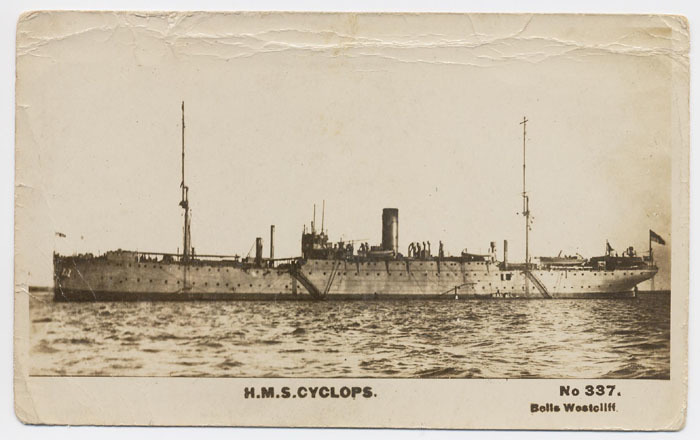
Like his brother Herbert, he was also in the Royal Navy.  Where his brother joined as a 15-year old boy, Percy joined the Navy after the outset of the war when he was 20 years old, offering his services as a blacksmith. Most of this time was aboard HMS Cyclops which was a repair ship for the Grand Fleet.  She spent the majority of the war stationed at Scapa Flow in the Orkney Islands, Scotland, and was also used during the Second World War as a submarine repair ship.

HMS Cyclops

Percy was with the Royal Navy until July of 1919.  He married Ellen Imogen Hooten in 1921.  He lived to the age of 62, passing away in 1957 in Bury St. Edmonds in Suffolk.