Ernest Stephen Moody

Ernest Moody, like his younger brother Bertram, was my 2nd cousin 4 times removed.  He was born in 1890 in Edmonton, UK.  He was married to Elizabeth Fitzer in 1909, at the age of 19.

Like his brother, his service record is not available, so I am left to piece together his service between his medal records as well as through some information from his granddaughter.  He served with the Hertfordshire and Lincolnshire Regiments, and his granddaughter was told that he had been injured by gas and had been sent back to England to recuperate in hospital.

James Moody

Ernest Stephen Moody is in the back row on the left.

Both the Hertfordshire and Lincolnshire regiments had been overseas as early as November 1914, so as the above picture is from approximately 1917, it is possible that by the time this was taken, Stephen had already been to France, had been injured, and had recuperated. He and Elizabeth had 4 children together.  Ernest passed away in 1976 in Hertfordshire, at the age of 85.


Bertram George Moody

Bertram George Moody was my 2nd cousin four times removed.  We are both descended from John Gill and Elizabeth Munns, my 5th Great Grandparents and his Great Grandparents.  While I am descended from John and Elizabeth’s daughter Sarah, Bertram is descended from her sister Alice.  Bertram and his brother Ernest were 2 of four grandchildren of Alice Gill  who served in the war. Stanley and Herbert Gill, who I have already profiled, were sons of Alice’s son William Gill who was born before she was married, and the Moody brothers were the children of her daughter with her husband Stephen Farrington, Harriet Amelia Farrington.

Harriet was born in 1870 in Edmonton, and married James John Moody, house decorator, when she was 19. Together, they had six children.  In the 1911 census, fifteen-year old Bertram was recorded as being in training to be a house decorator like his father and his brother Ernest who was a paper hanger.

James Moody

James Moody and Family circa 1917.  
Enfield, Middlesex, England
back row -L/R Ernest Stephen Moody snr., James Moody, Bertram Moody. seated – Elizabeth Mary Moody (nee Fitzer), Harriet Amelia Moody (nee Farrington), Elsie Alice Moody. seated front – Ernest Stephen Moody jnr, Gladys Jessie Moody. Lillian Evelyn Moody

I do not have his service record, but I know from the national roll of honour as well as from correspondence with his great-niece that he served in the 4th Leicester Battalion  as a signaller. According to the National Roll of Honour, he served at battles of Lens in 1917 and Bethune in 1918.

Honor Roll

Excerpt from National Roll of Honour on Bertram’s service.

I would like to thank Bertram’s great niece for giving me permission to use the amazing photo of her family, above.

Joseph Perring

Joseph Perring was my fourth great-uncle and the father of Edmund Alfred Perring and Alfred Charles Perring. One hundred and three years ago today, he attested to the British Expeditionary force in the Army Service Corps.

Attestation Papers

Excerpt from attestation papers of Joseph Perring.

By the time he attested, his son Alfred had already been overseas with the 1st Welch Regiment for over two months.  He claimed on his attestation papers to be 45 years of age.

Age claim

Excerpt from attestation papers of Joseph Perring.

This, it would become clear before too long, was a lie.  Joseph was born in Rickling, Essex in 1862, the second youngest child of  James Perring and Emma Law, who were also my 4th Great Grandparents.  By the time he was 21, he had moved to Edmonton (London), and he married Sarah Elizabeth Oliphant, a domestic servant. Together, they would go onto have thirteen children, Edmund and Alfred being the 5th and 6th respectively.  What possessed him to volunteer is difficult to say.  He was under no obligation.  Even once conscription arrived in Britain, it only applied to men under 41 years old.

Regardless, join he did, as part of the Army Service Corps which provided provisions and supplies to the troops at the front. It is unclear what part of the corps he served in, but he was in France from April to October of 1915 which included the timeframe when his son, Alfred, was wounded and eventually died of his wounds.

In October of 1915, Joseph’s lie about his age began to unravel.  He ended up in hospital in France that month due to “muscular rheumatism,” and was invalided back to England.  For the following several weeks he was able to perform occasional light duty, but by January of 1916, his medical status was being evaluated by the medical board.  He then revealed that his true age was in fact 55, and that he had suffered from rheumatic symptoms off and on since 1902.  He was discharged in February of 1916 as being no longer physically fit for war service.

He went on to live a long life, even living through the entirety of yet another world war, before passing away in Edmonton, UK in late 1949 at the age of 87.

John Edward Hewlett

One more brief post to get us back on schedule:  John Edward Hewlett was the son of Joseph Hewlett from his first marriage.  Although not related to me, he was half brother to Herbert Hewlett, and step son to Elizabeth Mungham.

John was five years old when his father married my cousin. His father was a rail engine driver, and as the family grew from three to seven children between 1890 and 1896, he followed in his father’s footsteps.  It is clear that he was a Sapper with the Royal Engineers, but beyond that, his service record is nearly illegible, so I cannot tell where he served or even with what units.

He was married before the war, and he and his wife had seven children between 1910 and 1921.  I do not have a date of death for John.


Herbert George Hewlett

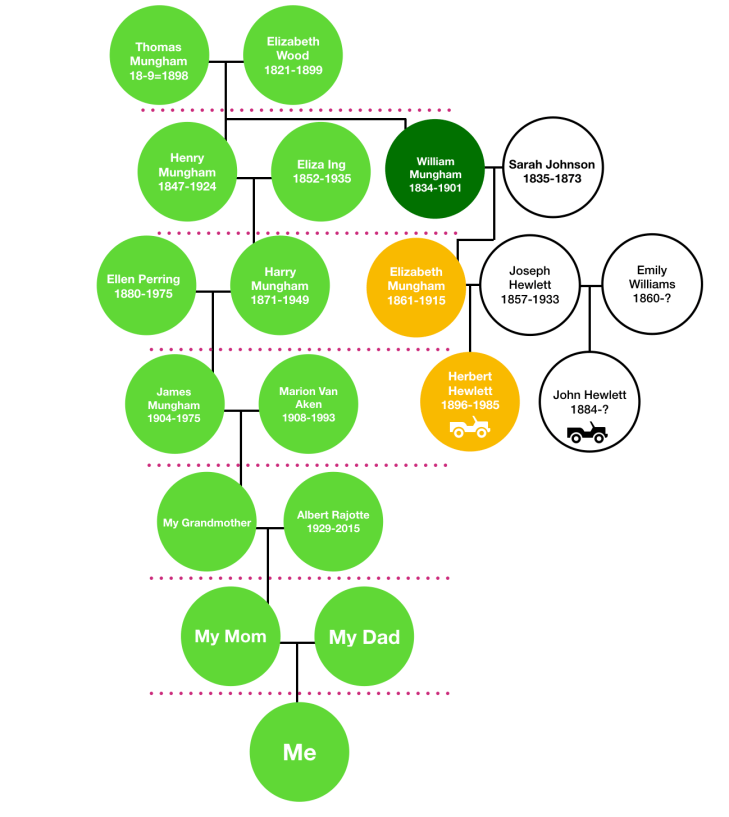
Herbert George Hewlett was my 2nd cousin three times removed.  We are both descended from Thomas Mungham, an agricultural labourer, and Elizabeth Sarah Wood who were my 4th Great Grandparents, and Herbert’s Great Grandparents.  They were born in Kent, England in 1809 and 1921 respectively.  They were married in June of 1841, but their son, William Mungham was already 7 years old at the time, which would have made his mother 13 at the time of his birth.  Whether this was indeed the case or William was a child from another union, he was certainly claimed by both as their son.  Herbert was descended from William, while I am descended from Thomas and Elizabeth’s third son, Henry.  In all the census data, William is listed as a labourer, sometimes agricultural and sometimes industrial such as on the railway.  He married Sarah Elizabeth Johnson in 1858, and they had six children together, including Herbert’s mother, Elizabeth Ann who was born in Kent in 1861.  In 1889, she married widower Joseph Hewlett who had three children from his first marriage, aged 8, 5 and 4.  Joseph and Elizabeth went on to have four more children together, the youngest of whom, Herbert, was born in 1896.

Hewlett

Abbreviated family tree of Herbert Hewlett

In the 1911 census, Herbert is listed as 15 years old, living with his parents and three of his older siblings, and working as a newspaper boy in Dover, Kent.  He joined the Royal Navy in May of 1915 when he was 19 years old as a stoker, being trained at Pembroke II in Chatham. He then served aboard the HMS Jupiter and HMS Blenheim.

He was aboard HMS Jupiter at a time where she was assigned to the Medeterranean sea to the Suez Canal Patrol, then to the Red Sea, then back to the Suez Canal with a home port in Port Said, Egypt.  This must have been an extraordinary experience for a newspaper boy from Dover. HMS Jupiter returned to England in November 1916, at which time Herbert spent some more time at Pembroke II, close to his family in Kent, before being assigned to HMS Blenheim in February of 1917.  This ship was a depot ship to the destroyer fleet throughout the rest of the war.

Herbert married three times in his life, and I found no indication that he ever had children.  He died in 1985 at the age of 89.

Wilfrid Lacasse

As happens with us all, life happened to me last week, and I did not get my post on Wilfrid Lacasse, my 2nd cousin 3x removed, completed.  Apologies for any confusion that the blank post may have created! This will mean you’ll see two posts from me this weekend, one on Wilfrid today, and another tomorrow on Herbert Hewlett.

Wilfrid Lacasse is one of only two members of my maternal grandfather’s family I am profiling over the course of this year.  I have a few theories about why that is, but most notably is the fact that my grandfather came from a French Canadian family in an isolated part of Northern Ontario.  French Canada was less likely to subscribe to the British imperial rhetoric driving recruitment, so the likelihood of enlistment was lower.  Also, being in a community where the main industry were mines and mills, men’s incomes were important to the survival of families, and the products of the work was considered important to the war effort.  Wilfrid is not only one of the only two members of this side of my family I will be profiling, he is also the only member of the American war effort I have as part of this project.

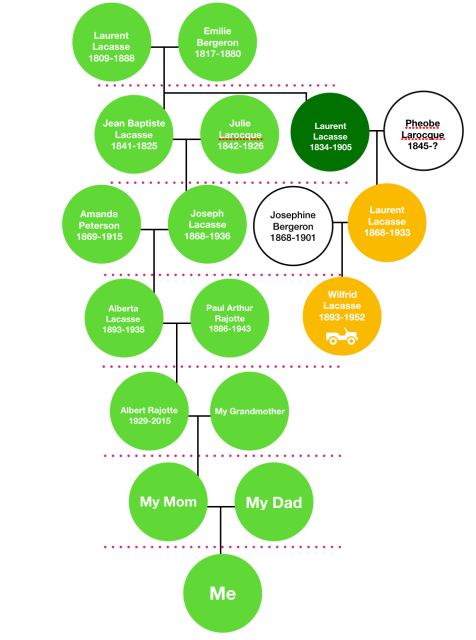
Wilfrid and I are both descended from Laurent Lacasse and Emelie Bergeron who were my 4th Great Grandparents, and Wilfrid’s Great Grandparents.  Both families extend back generations in Canada, with traces back to the settlement of “New France” around the St. Lawrence River. Both were born just south of Montreal, and, sometime after their marriage, settled in the Ontario community of Clarence Creek, just south of the Quebec/Ontario border.

Lacasse

Abbreviated family tree of Wilfrid Lacasse

While I am descended from their son Jean Baptiste, Wilfrid is descended from their oldest son, Laurent, and then his son, also named Laurent.  Wilfrid’s father and his mother, Josephine Bergeron, were both born in Clarence Creek, where they married and where their children were born.  In the 1901 census, completed early in the year, Laurent and Josephine are listed as living in Clarence Creek with with their four daughters and one son: Wilfrid.  In July of that year, Josephine died, leaving Laurent with five children ranging from one to twelve years.  By the end of the year, the family had moved to Michigan, potentially to be closer to his brother Felix, who already lived there.

Wilfrid was living in Alger, Michigan when the American forces joined the war in 1917. He was twenty four.  As I’ve written before, American service records were destroyed in a massive fire at the National Personnel Records Centre in St. Louis which destroyed 80% of service records of men discharged from American military forces between 1912 and 1960.  As such, there is no military file for Wilfrid, but there is a record of a request his wife made for him to have a military headstone upon his death.  This record states that he served as a cook at Camp Mills in Long Island, New York. This was a camp that was established in the autumn of 1917 as an embarkation point for troops leaving for Europe.  His period of service was less than a year, ranging from September 2, 1918 to July 1919.  Since the war ended in November of 1918, it is very unlikely that he served overseas.

He returned to Michigan after his discharge where he married Ruth McMaster in 1924 and began his family.  They later moved to Wisconsin where he lived until his death in 1952 at 59 years of age.


John Dash

John Dash, older brother of Herbert Dash, was born in 1887. Unlike his brother, was not part of the war from the beginning. In the 1911 census, he is listed as a boarder with a horsekeeper on a farm in Hertfordshire, with his trade or calling listed as a blacksmith.  On April 5, 1915, John married Charlotte Lilian Randall in Cobham, Surrey after which he returned to Cambridgeshire with his bride to the same cottages near Meldreth where his family lived.  Just over a month later, on May 14, 1915, he signed his attestation papers to the Royal Field Artillery and Royal Horse Artillery as a shoeing smith.

After training throughout the summer in England and undergoing journeyman testing and certification, his unit, the 100th Brigade, Royal Field Artillery in the 22nd Division, embarked for France in September of 1915.  After a brief two months, the unit was one of many that was assigned to the Mediterranean theatre of war in the fall of 1915 to provide military assistance to the Serbs who had recently been attacked by combined German, Austro-Hungarian and Bulgarian armies.

The Macedonian Campaign, also called the Salonika Campaign (about which the Salonika Campaign Society has collected a great deal of information), was established through the fall of 1915 and winter of 1916 at Salonika (now Thessaloniki), in Northern Greece. It was marked by several battles, and saw thousands of soldiers participate between 1915 and 1918, but receives much less attention than the Western Front.  It is perhaps best known for the thousands of cases of malaria that came from the ravages of mosquitos in the mucky conditions.

christmas card 22 [1600x1200] [1600x1200] [1600x1200].jpg.opt493x315o0,0s493x315

Christmas postcard from Salonika in 1916.

John was among those who spent some time in hospital due to his time in this theatre.  First, he was kicked in the mouth by a mule, an occupational hazard for a farrier, in June of 1916.  He spent nearly two months away from his unit before being discharged back to active duty on August 1, 1916.  His stint back with his unit was brief, as he was once again hospitalized on August 31, 1916, this time for malaria, one of over 162,000 cases of the disease that struck British forces in Northern Greece.  He was evacuated to Malta, where he remained in hospital for almost two months before being invalided back to Britain in late October 1916. By early 1917 he had been posted to the 19th Reserve Battery of the RFA, and served the remainder of the war in Britain.

Being back in England also allowed him time with his family, and in October 1917, his son, John Cornelius Aubrey Dash was born.  Sadly, being on the home front did not shield John from further tragedy. On March 6, 1919, one month after John had been discharged from his unit, his 16-month old son died due to complications from the influenza virus that had ravaged the western world throughout 1918 and 1919. I haven no record of John and Charlotte having any more children. John passed away in Cambridge in 1951 at the age of 63.


Herbert Dash

Herbert Dash, my first cousin four times removed on my mother’s side, was descended from Sarah Gill and Charles Bester, his grandparents, and my 4th great grandparents. As illustrated below, he is one of three brothers who served during the war.  His brothers, as well as two of his first cousins, will be the subjects of future posts.

Dash

Abbreviated tree of Herbert Dash.

Charles Bester, son of John Bester and Mary Constable, was born in Little Eversden, Cambridgeshire, in 1833, and Sarah Gill, second daughter of John Gill and Elizabeth Munns (of whom you can read more here), was born in 1837 in Orwell, Cambridgeshire.  They had ten children, including Annie Bester, my 3rd Great Grandmother, and Elizabeth Bester, born in 1863, Herbert’s mother.

Elizabeth Bester was the 5th of the Bester children. By the age of 18, she was a servant in the home of the Roads family in Orwell, Cambridgeshire. In 1885, at the age of 22, she married 19-year old farm labourer Walter Dash, also of Cambridgeshire.  They had seven children between 1885 and 1895, Herbert being the second youngest, born in 1894.

In 1909, 15-year old Herbert joined the Royal Navy as Boy, 2nd Class, beginning his service at HMS Ganges. Between 1910 and 1914 he served aboard several ships including HMS Berwick in the West Indes, HMS Hampshire (the famous ship that sank after hitting a mine in 1916, killing most on board including Lord Kitchener), and HMS Zealandia.

When the war began in the summer of 1914, 20-year old Herbert was aboard HMS Black Prince, which was stationed in the Mediterranean. The first part of the war was spent patrolling for German merchant ships, and by December 1914, she was transferred to the Grand Fleet.  Eighteen months later, she was one of 250 ships that engaged in the deadly Battle of Jutland. The German High Seas Fleet had hoped to surprise the British Fleets, but codebreakers alerted the British to the approaching ships.  The clash began on the afternoon of May 31, 1916 off the coast of Denmark.  Black Prince, approaching the battle with the rest of the Grand Fleet from the north, was somehow separated from the rest of the fleet.  At the time, what happened to the ship was a mystery to the British forces, but German records have since revealed that she approached the German ships in the darkness, potentially thinking the outlines of the ships were British, just before midnight.    This mistake proved deadly.  Once spotted, Black Prince was fired on by six German battleships.

Devon Heritage (devonheritage.org) cites an eyewitness account of the aftermath from a crew member who had been on board HMS Spitfire:

“We were just recovering from our ramming match with the German cruiser, and most of the ship’s company were collected aft, when suddenly there was a cry from nearly a dozen people at once: “Look out!”

I looked up, and saw a few hundred yards away on our starboard quarter, what appeared to be a battle cruiser on fire, steering straight for our stern. To our intense relief, she missed our stern but just by a few feet; so close was she to us that we were actually under her guns, which were trained out on her starboard beam, She tore past us with a roar, rather like a motor roaring up a hill in low gear, and the very crackling and heat of the flames could be heard and felt. She was a mass of fire from fore-mast to main-mast, on deck and between decks. Flames were issuing out of her from every corner.

At first sight she appeared to be a battle cruiser, as her funnels were so far apart but afterwards it transpired that she was the unfortunate Black Prince with her two centre funnels gone. Soon afterwards, soon after  midnight, there came an explosion from the direction in which she had disappeared.”

All 857 officers and crew were lost.  Combined, the German and British forces lost 25 ships and over 8,500 men that day.

Herbert Dash, along with many others who lost their lives at the Battle of Jutland, is commemorated at the Portsmouth Naval Memorial.  I am honoured to post a memorial certificate to my cousin here.


Frederick Arthur Baldock

Turning to a more distant relative, Frederick Arthur Baldock was my 4th cousin twice removed on my mother’s side.  We are both descended from William Mungham and Sarah Robinson who were my 5th Great Grandparents, and Frederick’s 3rd Great Grandparents. As a genealogical aside, William Mungham (1771-1848) of Doddington, Kent is as far back as I have traced my maternal grandmother’s maiden name.  Frederick is descended from William and Sarah’s daughter Sarah Ann, while my family is descended from their son, Thomas.

Sarah Ann Mungham, born in approximately 1795, married John Butler in 1815, and went on to have at least 14 children.  Their second son, John, born in 1822 in Newnham, Kent and his wife, Mary Strover had 8 children, the oldest of whom, Eliza Butler, born in 1842 in Newnham, was Frederick’s grandmother.  She married James Edward Baldock in 1865 in Faversham, Kent.  James Baldock is listed in the 1871 to 1911 census records as “farm servant indoor,” a “farm bailiff,” (he would have been employed by the land owner to ensure that tenant farmers were taking care of the farms and paying the rent on time, a “yardman” and “shepherd,” so his was an agricultural life.  James and Eliza’s first son, Alfred, was born in 1867, and was raised in this agricultural life.  As late as the 1891 census, he was still living with his parents, and in 1894, he married Rebecca Goldup in East Ashford, Kent, also working in the agricultural trade, then later as a maltster’s labourer for a brewer. Their first child, Frederick Arthur, was born in 1896. In the 1911 census, three years before the outbreak of the war, Frederick was 15, and listed as a school boy.

In the spring of 1914, two months before the formal beginning of the war, Frederick joined the Royal Navy training at Pembroke I (a shore establishment in Chatham, Kent) as an ordinary seaman. He had already served on HMS Queen, but was back at Pembroke I when war broke out in August of 1914.  By August 29, he was onboard HMS Undaunted, where he was promoted to Able Seaman, and where he served until the end of July 1917. In December 1914, HMS Undaunted provided support to the Cuxhaven Raid, a combined sea and airstrike with the goal of bombing the dirigible sheds housing German zeppelins.  The National Archive has an account of the raid from one of the pilots here. As the blog post points out, weather and the general riskiness of the operation meant that “the raid had not been a success in terms of achieving its target, since none of the seven aircraft was able to find the Zeppelin shed, but it was a milestone in the development of aircraft-carrier based operations.”

WW1Memoir-SmithGC1914CuxhavenRaid(1)

Contemporary postcard showing the Royal Navy surface force at the Cuxhaven Raid.

Frederick served throughout the rest of the war at a variety of shore establishments and ships, and was discharged in 1923.

He married Eva Ethel Law in 1922, and lived in Kent for the rest of his life, passing away in 1964 at the age of 68.


Walter Francis Bester

This week we move to a different branch of my maternal line with my 2nd cousin, 3 times removed, Walter Francis Bester.  We are both descended from Charles Bester and Sarah Gill who were my 4th Great Grandparents, and Walter’s Great Grandparents.

Charles Bester was born in 1833 to an agricultural labourer father in Little Eversden, Cambridgeshire about 11 kilometres south of Cambridge. Sarah Gill was born in 1837 in Orwell, Cambridgeshire to John Gill and Elizabeth Munns, whose history I detailed in a previous post. This makes her a great aunt to several of the Gill soldiers I have already written about.  Charles and Sarah married on 30 November 1856 when Charles was 23 and Sarah was 19. Together, they had at least 10 children, 9 of whom survived to adulthood. I am descended from their third child, Annie, who was my 3rd Great Grandmother, while Walter is descended from their first child, Charles, who was born in May 1856 (six months before Charles and Sarah were married). The first five Bester children were all baptized together in 1861.

In the 1871 census, when Charles was 14, he was listed as living at home with his parents in Little Eversden and working as a labourer. By 1877, he had relocated, and was working as a labourer in Edmonton, North London (the perennial spot for my ancestors, it seems!), and in January 1878 at the age of 21, he married 19-year old Fanny Adams. Charles and Fanny had nine children between 1878 and 1896, the two youngest of whom, Frank Harold Bester and Sydney Smith Bester both served in the Great War and will be profiled here later this year.

Charles and Fanny’s oldest son, Walter Beaumont Bester, began working at a young age like his father, and is listed in the 1891 census at the age of 13 as a “Milk Boy.” He married Alice Louisa Goodchild in 1898, and their son, Walter Francis (or “Frank” as he went by later in life), was born in Hackney, a more central area in London, in January 1899. It seems that Walter Sr. had stayed with his early occupation, as in the 1901 census he is listed as a Milk Carrier. In 1910, Walter, Alice, and 11 yr-old Frank sailed from Liverpool to Quebec City with the intention of farming in Canada. They settled in Winnipeg, Manitoba.  Whether the family every did attempt to farm in Manitoba is unclear, but by the 1916 Western Canadian census, Walter was once again listed as a Milk Carrier, with 17-year old Frank listed as a farm labourer.

On the 6th of April, 1917, Frank enlisted in the Canadian Expeditionary Force.  As an aside, one of the most interesting things to me about his attestation papers is that his trade or occupation is listed as a “moving picture operator.” There is a lot of scope for the imagination in this–he would have been consistently exposed to the jingoistic and propaganda-filled newsreels that accompanied the films, and I have to wonder what kind of impact this had on his impression of the war. He enlisted and served in Lord Strathcona’s Horse, one of the most decorated Canadian regiments in the War, and a regiment still in existence today with its home base being in my home town, Edmonton, Alberta.

Frank embarked for England on April 29, 1917, and arrived on May 7 at which time he was sent to the Canadian Reserve Cavalry Regiment in Shorncliffe for training and to await posting. He was mobilized to France and sent to join the Lord Strathcona’s Horse nearly a year later in April 1918.  Frank joined the regiment at a time of significant rebuilding.  In fact, the war diary of the regiment stated on April 6 that “every effort [was being] made to collect reinforcements from various parts of the country.” From mid to late April, the regiment was making good on those efforts and working to train the men they collected. May and June were largely spent engaged in training rides and grazing parades keeping both men and horses ready for action.

Training and conditioning continued through July, but, fortunately for the men, the month is marked more by sporting events more than by military action. On July 1, Dominion Day, the troops played baseball throughout the afternoon and evening. Later in the month, there is also reference to a basketball game that roused “great enthusiasm.” On July 19th it was reported that the regimental baseball team was defeated by the Royal Canadian Dragoons team, 4 to 3.

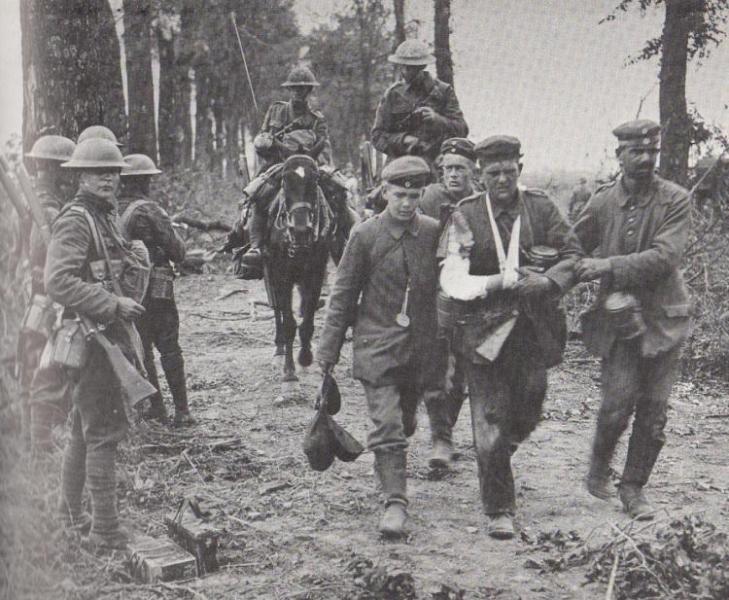
No one would grudge the regiment their leisure considering what was to come.  On August 8, 1918, the Lord Strathcona’s Horse was part of what would be a tremendous 9-day effort to push the German Forces east: away from the key railway junctions at Amiens. From 4:20 AM onwards, the regiment was monitoring the advance of infantry and tank brigades, and following behind to clear areas of remaining opposing forces as advances were made.  Eventually, rather than wait for the slower advancing tanks and risk being caught in the crossfire, leadership decided to advance without the tanks and run ahead at a gallop.  This resulted in a significant amount of prisoners taken and equipment captured. General Ludendorff would refer to this first day of the Battle of Amiens as “the black day of the German army.” Though there were many successes that day, there were also several casualties, one of whom was Walter Francis Bester who had received a gun shot wound to his right calf and a large shrapnel wound to his left buttock.
amiensphoto1

German prisoners are escorted by Canadian cavalrymen near Amiens. Library and Archives Canada Photo.

Frank was evacuated to Britain: first to the 4th Southern General Hospital in Plymouth on August 11, 1918, then transferred on Aug 22 to the Canadian Convalescent Hospital, Bear Wood, Wokingham, Berkshire where he recovered until discharged on October 4. At this point he was posted to the Canadian Reserve Cavalry Regiment in Shorncliffe where he stayed until the end of the war. On December 4, 1918 he was sent to Kinmel Park where he embarked for Canada on December 10. He was discharged January 23, 1919 in Winnipeg, where his wounds were assessed as well-healed, with no impairment or disability.  He was 20 years old.

Later that same year, Frank married Nellie Alice Hollingsworth who he must have met while stationed in England.  She arrived in Canada on July 2, 1919 with the words “to be married” stamped on the passenger manifest beside her name.  Frank and Nellie were married on July 29. In the 1921 Canadian census, Frank is listed as a farmer living just outside Winnipeg with his wife, his 1-year old daughter Joyce, his mother, and his maternal grandmother.  Although his mother is not listed as a widow, I could find no trace of Walter Beaumont Bester in the Canadian census from that year. As it seems that Alice passed away in England, it is possible that he had returned there as well.

Frank and Nellie had one more daughter, Jaqueline, in 1922.  In 1937, Frank, Nellie, and Jaqueline moved back to Britain, with Joyce following in 1939 all indicating that they would be residing in Essex. Jaqueline eventually returned to Canada to live, while Frank and Nellie both lived out the rest of their lives in England.  Nellie passed away in 1954 at the age of 58, and Frank in 1964 at the age of 65.